

The hottest, driest summer on record is coming to an end, and all through the digital ether the call is going out: “THE MOVIES ARE BACK. THE MOVIES ARE BACK.” This month marks my first year as film critic at The Metropolitan Review, so perhaps it’s time to editorialize and examine the claim. Are “the movies” indeed “back”? Are young people about to witness a renaissance the likes of which no generation has seen since those rolling New Waves of the ’60s? Have short-form video and prestige TV and AI slop finally been driven back into the hell they came from, replaced by that rightful queen of the modern age, the cinema? Is there a limit to the number of rhetorical questions a critic is allowed before his readers realize he’s delaying a conclusion he doesn’t have the wit or the care to claim?
Well, I hope I’ve made it clear this past year that if there’s anything I intend to do, it’s to serve as a stubborn impediment to such narratives. In fact, I barely conceive of myself as a critic at all. “True criticism,” wrote Harold Bloom, “recognizes itself as a mode of memoir.” Or, as Robert Warshow put it: “A man goes to the movies. The critic must be honest enough to admit that he is that man.” But this doesn’t mean only men, thank God: it means women, too, and even French people. I’m thinking of Pauline Kael, without a doubt the greatest of American film critics, and the most sublimely frustrating. Not only was the great Pauline absurdly ambivalent and incorrect about so many extraordinary films of the 20th century, she remained stubborn and cynical to the bitter end. Still, there’s an ineffable something to her writing: a sense of celebration, of movies as a grand civilizational fête; a conviction that the cinema is the triumphant dream medium of our haute technological age. She writes as one of us — we wide-eyed and slack-jawed dreamers in the dark of the theater — and she demands the best on our behalf.
I’m also thinking of André Bazin, Frenchman and co-founder of the Cahiers du Cinéma, the critic who best articulated what film really does, by shaping time and space within the frame. The foment of that legendary publication not only licensed the whole world to go beyond what Hollywood had concocted as an experiment in dreaming for the masses, it restored to Americans the status of supposedly “lowbrow” directors critics had dismissed for years: geniuses like Alfred Hitchcock and John Ford and Orson Welles. Between these two critics, neither of whom wrote from anything but a personal conviction that a life spent loving the cinema was a life well lived, I choose to plant my own proud snobbish flag and declare that: 1) cinema, now inseparable from the dreams of our world, will never truly die; and 2) “the movies” may indeed be back — at least from the perspective of studios and ticket booths — but this hardly means we can hope for some new great age of the cinema.
That’s not to say we can’t try for it, or that there isn’t any good news. There are plenty of genuinely stirring success stories this year, and the box office is projected to reach its highest worldwide since before the pandemic. Letterboxd and TikTok and an apparent desire to make up for years of generational antisociality have conspired to drive masses of (apparently young) people into the kind of large, dark, air-conditioned boxes you just can’t approximate at home. So you have Spider-Man: Brand New Day with the biggest domestic opening weekend ever, already passing $2 billion, while The Super Mario Galaxy Movie and Toy Story 5 have each passed $1 billion. Of those, I’ve only seen Spider-Man (which wasn’t nearly as bad as I expected), and don’t intend to see the others. But these aren’t the only enormous box-office successes.
The only non-sequels to have passed $1 billion this year are Antoine Fuqua’s Michael, which you couldn’t pay me to see, and Christopher Nolan’s The Odyssey, which I reviewed here last month and found mind-numbing. Two of the other biggest films of this year, Minions and Monsters and The Devil Wears Prada 2, are also sequels I’ll never see. This leaves the Chinese racing film Pegasus 3 and the real surprise hits of the year, Project Hail Mary and Obsession, with A24’s Backrooms not far behind. Still to come, and sure to make it big, are Avengers: Doomsday and Dune: Part 3, both due in December. The former looks like a gray sludgy mess, the latter like it could be profound. I found Denis Villeneuve’s first Dune pallid and bombastic, but was enchanted by the extraordinary second part, which improved so much on the first’s color and pacing that it struck me as some kind of future classic. If Part 3 makes similar improvements — Linus Sandgren’s photography already looks better than any major film has in years — we might just have another classic on our hands.
I’ll soon get to the films from the middle of this year that actually do make a decent argument for the return of “the movies” (decent, not complete). But first, that list above. How can we not be dismayed by the sheer number of sequels these studios keep pumping out, and saddened that people keep turning up for them? Admittedly, it was heartening to see Disney’s miserable-looking live-action Moana and The Mandalorian and Grogu fail to meet their projections. But I’m hopelessly old-fashioned, and can’t help but find it tragic that only one massive success of the year so far, Obsession, was actually an excellent movie. I understand why Project Hail Mary did well with audiences, with its quirky millennial warm fuzzies and popular sci-fi source. Ryan Gosling’s a great, genuine movie star, and Greig Fraser is a great DP; but as directors, Phil Lord and Christopher Miller are as dull and haphazard as the Russo Brothers. You only have to watch the sections set on Earth to realize that even our blockbusters are doomed to look like the soft-lit gray of streaming TV shows.
Of course the bulk of this “movies are back” discourse has centered on the astounding success of Backrooms and Obsession, which I can only agree is a good thing. Backrooms is a fascinating failure. Kane Parsons’ original videos were genuine aesthetic accomplishments: whatever you think of their deeper meaning, they’re fairly brilliant works of internet art, made by a kid with obvious precocious talent. But A24 and screenwriter Will Soodik hamstrung Parsons when they handed him the mandate to make a “normal” horror movie out of what’s really a conceptual, environmental art piece. There is a lot of talk now about studios scouring YouTube for similar young phenoms. Yet for all its financial success, Backrooms shows how the YouTube creator-to-filmmaker pipeline isn’t guaranteed to yield great movies — particularly when the film is based on a liminal “concept” rather than a story handcrafted by an individual filmmaker.
This is why the more traditional genre trappings of fellow YouTuber Curry Barker’s Obsession work, where Backrooms’ awkward collision of cinematic and internet and video-game mediums doesn’t. Obsession doesn’t innovate much beyond carrying Kiyoshi Kurosawa’s specific J-horror dread into an American context. Much of its success clearly stems from the ambient sexual paranoia it taps into. But to be blunt, the bulk of it has everything to do with Inde Navarrette’s face and voice. Has any actor had this much immediate cultural impact this century? The film plays queasy games with her uncanny beauty, yet her performance fearlessly matches it, rising to a level of chaos I haven’t seen in an American film in a long, long time. Her mania, at times threatening to break out of the claustrophobic film around her, creates a perverse catharsis for the audience, followed by the nervous recognition that this catharsis comes at a horrific cost. In other words, Obsession has subtly reintroduced the ancient cinematic issue of voyeurism to a generation raised on half-baked ideological critique and fixation on “the gaze.” This can only be a good thing.
But critics and commentators have seriously overstated how much the success of these two films suggests an “independent renaissance.” True, repertory theaters everywhere appear to be doing well. But if showing “classics” at indie cinemas means programming Back to the Future and The Matrix for the thousandth time, it does nothing to spread the true gospel of cinema. Are young people learning about Kurosawa, Ozu, Renoir, Eisenstein, Murnau, Fellini, Antonioni, Bergman, Godard, Varda, or Kieslowski? My point is this: if we do see a boom in young filmmakers with better budgets, encouraged to try some original vision, will this result in great cinema? Will kids raised on YouTube and The Dark Knight really make great films? Or will we get a few dozen more small horror movies and thrillers with a bit more style and cultural relevance? “Independent cinema” has mostly been colonized by studios like A24 and Neon — which have brought us plenty of classics between them but have diverted most of their original energy into brand maintenance. I see little evidence of aesthetic or artistic vision beyond the dictates of the market.
I’ll believe we’re undergoing some kind of “indie renaissance” when young millennials and zoomers start making elegant comedies, or weird road movies, or anything with a bit less of the contemporary film-school touch and a bit more of the Old Hollywood facility with mise-en-scène. Even the great filmmakers of the last indie boom, in the 1980s — like the Coen Brothers, David Lynch, David Cronenberg, Jim Jarmusch, Steven Soderbergh — understood depth of field and blocking in a way continuous with classical Hollywood, just as the directors of the 1960s New Hollywood revolution did. In other words, have the zoomers read their David Bordwell? You can’t enact a revolution unless it’s composed of artists who have mastered a tradition and are prepared to break with it. But filmmaking has, on the whole, become so cheap, quick, and lazy since at least the late 1990s that it’s hard to imagine most emerging filmmakers could even recognize what their milieu lacks next to the classic periods of the form. In the end, none of this box-office success or new independent energy matters unless it gets redirected into art.
However, I have seen three good films this summer that did seem to signal some kind of shift — they were genuine entertainments, and for all their contemporary resonance, they had a timelessness I couldn’t help but admire. The first is Spielberg’s wonderful Disclosure Day. I still don’t understand people’s objections to it. Style, tone, and energy are everything, and the film had these in abundance. The job of a film like that is to thrill and to dazzle, not to make sense, not to “mean something” or conform to the real world. Spielberg remains a tremendous pure filmmaker, undiminished, and the film’s failure to find a large audience is sad, given how entertaining it is.
The other two are Olivia Wilde’s The Invite and David Robert Mitchell’s The End of Oak Street. Neither is particularly great, but both are wonderful examples of that species of movie once called an “audience picture.” Though a bit overcooked and overdetermined, The Invite is one of the better comedies in recent years, and Wilde’s direction is surprisingly deft, clever, purposeful. It’s a profoundly millennial film, starting like a prelude to an Almodóvar kinkathon before devolving into a therapy session. But, crucially, it seems as interested in the actual form and tone of each scene as in what the film is “saying” — it’s a victory of form over content, and all the dull, denuded things that word has come to mean.
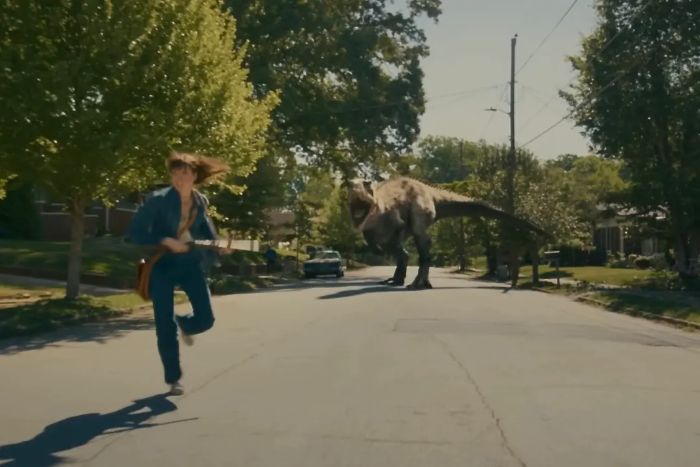
Mitchell’s The End of Oak Street has been billed as a Spielberg nostalgia piece, with dinosaurs and suburban families and everything, and not for nothing is it produced by J.J. Abrams. But unlike all those interminable Jurassic World movies, or Stranger Things, or even Abrams’ Super 8 (for my money the best of the last two decades’ nostalgia trips), Mitchell seems to have set out to make a very good Twilight Zone episode, with an eye to Brian De Palma over anything truly Spielbergian. Despite aging somewhat poorly, his previous films It Follows and Under the Silver Lake were exceptionally well directed. Here he gets great effects from split-diopter shots and long telephoto zooms, and stages a few magnificently Hitchcockian moments that use the many-leveled yards of the film’s suburban neighborhood for real suspense and dramatic payoff. Watching it, I realized how important a proper sense of pacing is to a film like this — precisely what’s been missing in tentpole films for at least a decade. And though there are interesting themes to be plucked out from the subtext, the real fun is watching someone finally get this whole science-fictional dinosaur-meets-nuclear-family thing right, for the first time since Spielberg did. Good as the performances are, it’s the clarity of Mitchell’s big set pieces that carries the film off — especially an unforgettable encounter with an enormous snake, one of the tensest moments I’ve seen in some time. It’s a shame more people haven’t seen it, since The End of Oak Street is precisely the kind of nuts-and-bolts entertainment that’s been missing in our summer fare.
There are surely great films to come this year. Paweł Pawlikowski’s return with Fatherland, Robert Eggers’ Werwulf, Rafael Manuel’s Filipiñana, Na Hong-jin’s Hope, Kent Jones’ Late Fame, Kiyoshi Kurosawa’s The Samurai and the Prisoner: I’m excited to see them all, and I imagine a few might even end up great. We’ll see. There are always great films. People will always be making great movies. As I said, the cinema will never truly die. But most of what is great in today’s cinema is kept far from big audiences, while big audiences just get the same mid-to-low-tier blockbusters, ad nauseam. In 2026, audiences at least seem fitfully interested in a better kind of blockbuster. When they start to get their better blockbusters, when they start to see what happens as more interesting young directors are given proper budgets and promotion, perhaps they’ll get a taste for something they haven’t had in a long time. Perhaps they’ll begin to remember the difference between “the movies” and that true art of dreaming, the cinema. Here’s hoping.

Sam Jennings, The Metropolitan Review’s film critic, is an American writer living in London. He is an Associate Editor at The Hinternet, and he runs his own Substack, Vita Contemplativa. For those interested, his Letterboxd account can be found here.