

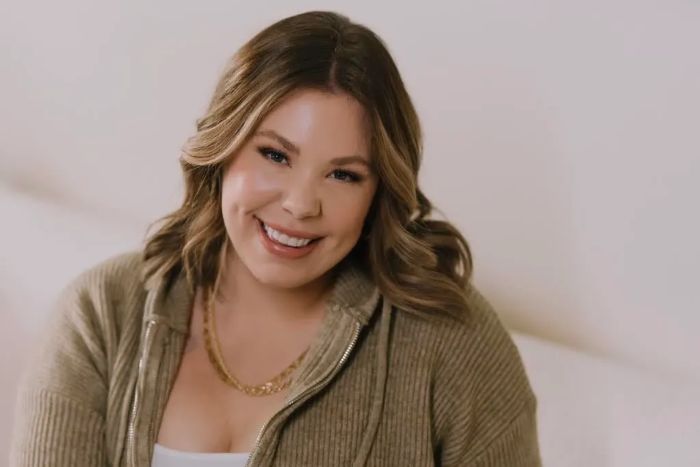
Kail Lowry is an influential podcaster, author, and a mother of seven who rose to fame as a star on the MTV franchise Teen Mom, which followed the lives of girls and young women who became pregnant at a young age. The Teen Mom franchise, which included the shows 16 and Pregnant, Teen Mom, Teen Mom 2, and others spinoffs, became a cultural phenomenon and still has an enduring fanbase. It has even been credited with contributing to a declining teen birth rate in the United States. But it was often exploitative, sometimes making a spectacle of the lives of girls across the country who were typically from low-income backgrounds and lacked strong parental support. What the franchise didn’t capture was Lowry’s relationship to literature. Today, she is a podcast mogul and book aficionado, and runs Chapter Seven Book Club. Senior Editor Vanessa Ogle spoke with Lowry about why she is intentionally making time to engage with books on and off the screen, especially in a world where social media is prominent and profitable. Their conversation has been lightly edited and condensed for clarity, and the full audio is available on Class is in Session.
–The Editors
Vanessa Ogle: You’ve written memoirs and even a children’s book, but most know you from reality TV, your podcast empire, and social media. Why is it important for you to still make space for literature in a world where social media can be more profitable?
Kail Lowry: For me, I felt like I was spending too much time on social media. I was doomscrolling for a long time. I didn’t really feel like I could be present in anything I was doing because I was so busy making content or consuming content. I was like, I need to get some brain cells back. I need to start reading, I need to pick up a hobby, I need to do something that is going to inspire me or give me new perspective. I felt like I need to read and it kind of turned into me being able to make content and consume content about what I’m reading, which is real conversations. We don’t have to have a highlight reel of all the best things when I can talk about the good, the bad, the ugly about the book I just read, so it kind of really became a hobby and then a passion project on social media to be able to talk about it.
VO: Yeah, that’s awesome. So, you’ve talked about the exploitative nature of Teen Mom. Do you feel writing has allowed you to reclaim the narrative around your life and tell your story?
KL: Yeah. Actually, I’m working on a rewrite of my first memoir because even at that time — I think it was 2014 — I . . . was still a little bit shy about really digging into all of the things of my childhood so I’m rewriting that and there’s so much more to my story that I didn’t include for those reasons and I do feel that, writing, I get to take my power back and explain things from a bigger, broader perspective. Yeah, I mean, writing has been a really good outlet for me.
VO: What do you feel like people get wrong about fame and success at such a young age?
KL: I think that fame or any sort of people recognizing you from social media or reality TV or wherever they recognize you from does not equal success. It also doesn’t equal money. Just because people know who you are, doesn’t necessarily mean you are successful and you have money or a financial plan. . . . And I read a comment yesterday. It was, “Oh great, you got knocked up. I wish I would have gotten knocked up to make all this money.” And it’s like the sacrifices that I had to make, and at first unknowingly make, is not a tradeoff. Right? Sometimes the sacrifices are not worth the fame and the things. I’ve seen some of the other cast members, and this is no shade to them at all, not propel themselves and launch themselves into different directions and not go to school or get an education or have a career on standby or tackle a career simultaneously with the show, so just because you’re on TV doesn’t immediately equal success or income.
VO: You prioritized getting a college degree while being a young mom. Do you feel like education is still a pathway to a more stable life, even with rising education costs?
KL: I’m conflicted on this. I do feel like education, regardless, is so important, whether it’s a trade school or your AA or BA. However, I’m not of the mindset that everybody should go to college at this point. I think the cost of college and the benefits of it aren’t necessarily what they were 10 years ago, 15 years ago. Yes, education is so important, but I do not believe college is for everyone and I do not believe that every single one of my kids should go to college. I think it really depends on the child, on the person, and there are other ways to educate yourself outside of a college or four-year university.
VO: I also come from a working-class background and have had experience loving people with some of the similar addiction issues that you’ve talked about your parents having. Do you feel like there is space for women like us in the literary world where there can be these elitist ideas around who is allowed to be a writer?
KL: I think everyone should be a writer. I think no matter what your experience is. Maybe you had a perfect childhood. I talked to Jodi Picoult the other day for my podcast and she was saying how great her life was and her childhood was and, you know, she still writes about the people who struggle with their lives. So I think that everyone should write.
VO: What would you tell your childhood self about money? How has it made your life easier and have there been any unexpected complications from being a high earner?
KL: That’s a loaded question. If I could go back. . . . The first question, what would I tell my childhood self about money? Well, I would have saved every single birthday, $20 bill, $5 bill I’d gotten if I knew how expensive life was going to be. But I think the biggest thing for me is just to invest in yourself and invest in your future. It’s so hard to explain it to kids because obviously instant gratification is . . . everybody wants it. Not just adults. Kids do, too. They get money, they want to spend it. But I think I do a pretty good job in keeping my kids in the loop in how to spend, what to save. For a long time, I had money, just blowing through it, nothing to show for it. But I talk to my kids a lot about investing. A financial plan. A trust. A will. All of those things. And so, that’s what I would tell my younger self. Go get a life insurance policy instead of when I’m in my 20s. You know, things like that, if I could go back in time and do all those things, but you know I just didn’t have the financial literacy or the guidance or the resources. I didn’t know what to do and what I was doing. I can’t go back and tell my younger self but I can tell my kids.
VO: And you touch on this a little bit too. People think just because people know you, you’re making money, right? And not necessarily. This can be an exploitative industry. So what have been some of the unexpected complications now being this high earner?
KL: Everyone asks Kail for money. This is the Bank of Kail. It doesn’t matter if I’ve never met this person and this is a stranger on the internet. Or somebody in my life. And nobody thinks twice. If we go out to eat, nobody is like, “Kail, do you want me to get it this time?” It’s expected. And then I think a different sort of complication I’ve experienced is — and I’m in a sort of weird place with my kids — I grew up in poverty. I didn’t know anything about anything when it came to finances. But on the flip side of that, I’m raising seven kids who are flying first class to London. They’re going to Morocco for spring break. They don’t understand. I’m teaching them the literacy. But they may not make the same amount of money that I have. So one, I don’t want to see them blow it. And two, I don’t want to see them just giving it freely to people like I have over the years. I mean, people, “Hey, do you have four grand?” “Hey, can I borrow this?” “Hey, my mom’s grandma’s uncle needs $50. Can you send them?” That was unexpected. I never anticipated when I started making money that people would come out of the woodwork. And what’s interesting is it’s never been my parents. It’s never been my immediate family members. It’s always been everybody else. And my mom struggling with addiction, you’d think she’d be the first one with her hand out and never once has my mom asked for money.
VO: And what are some of your favorite genres to read?
KL: I surprised my own self with loving historical fiction. Growing up, I joke — it’s not funny — but I didn’t get to like reading as a kid because I was so hungry all the time, so I literally couldn’t focus on school all the way up until I would say high school. And so I never could get . . . [I] couldn’t zone in in school. And so now as an adult, I get to pick what I read. I surprised myself so much. I will literally read anything contemporary fiction, but I really, really love historical fiction and thrillers, obviously. Who doesn’t love a good thriller? But I really like the realistic thrillers. I don’t like the ghouls and ghosts.
VO: Are you a Freida McFadden fan?
KL: Yeah, Freida McFadden, she’s great . . . I love Freida. She always puts out a good book that will get you through a reading slump. You read something heavy, you can always turn to a Freida book to put you in good spirits. I don’t know, I love Freida. Jodi Picoult is great. I love Kristin Hannah books.
VO: I like Kristin Hannah, too.
KL: Yeah, I’m excited. She just announced her new book and I’ll be excited to get that one. And then someone just sent me an advance copy of [Rebecca Yarros] . . . this one’s a big girl, though.
VO: Yeah, that’s thick. You’re going to have to take some flights, do some reading on the plane.
KL: Yeah.
VO: I love having you as this well-known reader because it’s very inspiring and it gets people reading and off their phones more. Anything else you want to add?
KL: Let me actually add this. I run a book club online, Chapter Seven Book Club, where we meet once a month and we get to talk about all the books. And so if I can inspire one other person to pick up a book, I don’t care how big, how small, YA, literary fiction. Anything. Let’s talk about it. We need to be talking about what we’re reading and not what’s on social media all the time. Thank you so much for having me.
