

No beating around the bush here, since the film itself doesn’t: Na Hong-jin’s Hope is extraordinary. Is it also ridiculous, bloated, and a bit overlong? Sure, yes, who cares. Is it trolling its audience with its last-act alien shenanigans? Possibly, though a sequel is (hopefully, eventually) on the way. Is it given to dangling important threads in front of its audience, only to distract them with the equivalent of a piano falling on someone’s head? Absolutely. But none of this matters. Not a whit. Because director Na has crafted his own, singular kind of cinema — one that begins as perhaps the world’s first truly Korean Western, before morphing into an ’80s police movie, then into a ’50s small-town B-grade sci-fi flick, then into a beautifully strange riff on Jaws, and eventually into an out-and-out intergalactic fantasy. All while he and his team pull off what might just be the greatest action movie of the decade.
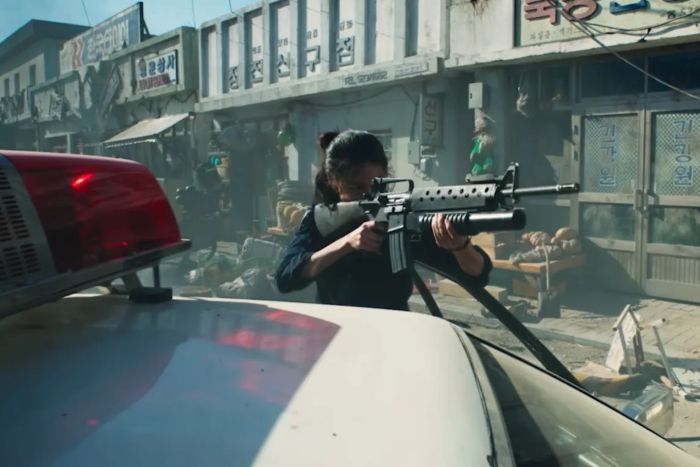
The “Hope” in question is Hope Harbor, a tiny fictional fishing hamlet on the coast of South Korea, apparently not far from the DMZ, and our protagonist is Police Chief Bum-seok (Hwang Jung-min). In the film’s very first moments, Bum-seok has been called in by his cousin Sung-ki (Zo In-sung) to investigate the ravaged carcass of a cow, which he suspects may have been mauled by a tiger. Sung-ki and his hunter buddies (looking for all the world like American hicks, in flannel and denim and ball caps, driving old pickup trucks) take off for the woods, while Bum-seok heads back to town, only to find half the place in flames, and carfuls of elderly villagers with machine guns chasing after an unseen creature. It’s here that the film first starts splitting itself into the genres it will later pile up, one on top of the other: the blustering comic policeman, suddenly trapped in a B-movie creature feature; and the Korean cowboys, stumbling into an outright sci-fi fantasy.
To Na’s credit, he keeps the first creature offscreen for a considerable amount of time: he has an extraordinary ability to take a set piece and drag it out and out and out even further, sometimes simply by having the action turn around and go the opposite way (which itself becomes a recurring joke). This isn’t the first clear lesson he takes from Jaws, either: a later autopsy of the creature takes that film’s memorable gutting of the pseudo-shark and raises it to a ridiculous pitch, with the local medical expert blithely taking a chainsaw to the indestructible corpse as she straddles it. But Bum-seok’s first encounter with the creature, in a sequence that probably lasts close to 40 minutes on its own, isn’t just a masterclass in movie action from a limited point of view — it revels in a kind of maximum tension-and-release I’ve never quite seen in a film like this before, a dizzy willingness to follow whatever weird tangent happens to come along, even at the risk of interrupting its own momentum.
That is, those 40 minutes themselves contain several unbroken chase sequences, each of which just keeps going on and on until you reach the audience equivalent of a runner’s high. Yet Na is just as likely to halt the action for a bit of mordant slapstick — as between Bum-seok and the bow-wielding elder he meets back in the destroyed town, who becomes a de facto deputy, a Sancho Panza to the cop’s Quixote. Bum-seok’s only other ally arrives in the form of rookie Im Sung-ae (supermodel and Squid Game star Hoyeon), who just manages to rescue him from the creature. Immediately cussing and childishly angry, though of course plucky and indomitable, Im Sung-ae is the genuine heart of the film — the last piece of the puzzle, which once it really clicks into place, shows the film for the old-fashioned romp it is (though it certainly subverts this fact throughout its runtime). And Hoyeon is simply wonderful, in a truly great part that proves her a rare type of comic actress — particularly during the scene, mentioned above, in which she listens to the story of an old man who witnessed the creatures in the woods, while answering the call of nature (one of the funniest scenes of the year, which had the audience at my theater cackling).
However, like his countrymen Bong Joon Ho and Park Chan-wook, Na is brilliant at having his cake and eating it, too: their films often burlesque certain Western archetypes, yet in their convictions they show what’s missing these days from the original itself. The contemporary Korean arthouse is infamously bleak, and bleakly violent — yet it’s also comfortable with a sort of broad, exaggerated emotion (even to the point of stereotype) that Western writers and directors see as awkward and old-fashioned, which is why they generally undercut it with snarky quips and hyperawareness of the “So that just happened . . . ” variety. But in Hope, as in many other modern Korean classics, it’s understood that comedy comes from characters invested in their own actions with an intensity that becomes ridiculous. Hope has a lot of fun with this. And because it brilliantly provides us with next to no backstory or context for these characters, the thin sketches we doget feel truer to their original genre trappings, in the Hollywood of the ’40s and ’50s. Since for all its Hitchcockian and Spielbergian ambience, Hope is much more in the lineage of those shaggy hangout shoot-’em-ups, from John Carpenter all the way back to Howard Hawks.
Meanwhile, as Bum-seok and Im Sung-ae clumsily try to contain the chaos in town, the hunters in the forest are stumbling into something right out of Alien, and soon the extraterrestrial visitors are explicitly revealed (it’s no spoiler to say that they are played by famous Western actors: Michael Fassbender, Alicia Vikander, and Taylor Russell). Before long, another insane, exhausting chase is happening — this one involving horses and tall trees and creatures so fast they can barely control their own slaloming bodies. The CGI, here and elsewhere, is wonky and peculiar, occasionally terrible, yet this only adds to the sense of alien uncanniness. And the now-smooth-now-jerky computer-generated figures are integrated so well into the practical stunts and effects of the film, it hardly matters anyway. There are scenes in the forest, and back in the town, where the creatures move at such a crazy high velocity, you feel a wildness — a sense of real chaos, just barely contained — that’s nearly impossible to find these days in any film not made by George Miller.
Of course, this sense of chaos is obviously the work of incredible precision and control — and this is where Hope seems frankly incomparable to most modern action films. Apparently the most expensive movie ever made in South Korea, it benefits immensely from being set in such a remote location, where Na can put all that money into building his full-size town (there are very few moments in the film’s jaw-dropping production and set design that don’t feel completely, physically real) and blowing it up; then running his cameras at high speeds up and down the narrow streets, then through the trees, later down an empty highway. In each location, every long drawn-out set piece almost has a real-time feel — at times like a particularly immersive video game. In fact, Hope does occasionally seem to run on the logic of video games. But contrary to something like Zach Cregger’s Resident Evil — a well-made but empty filmic extension of a medium (third-person shooters) that already aspires toward the filmic — that “do-this-do-that-now-go-here-now-go-there” logic, in Na’s hands, actually frees him up to make a fresh cinematic experience, rather than a movie bound by a different medium’s conventions.
It was during that final highway sequence, before the finale’s open-ended left turn (which I will not spoil, though it’s hilarious, abrupt, and confounding), where I started to see what Hope was up to. At a certain point in the sequence, it seemed as if the chase simply wouldn’t end. The same repetitive actions kept happening, and happening, with Na clearly trying to see just how close he could get to a natural finish, before delaying it yet again — something that will surely be taken as a teasing meta-commentary on action film clichés, though I suspect Na is being more ironic even than that. Indeed, as soon as our main characters experience what they think is a huge victory, they cheer like gleeful idiots, in disbelief at the action-movie moment they just perpetrated — which is then immediately undercut by more comedy (one joke throughout the film is that some characters, like the creatures themselves, are hilariously unkillable). Then something incredibly strange and world-altering happens, and the film overturns itself again, leaving itself wide open for that possible sequel.
I can’t quite believe I’m saying this — eternal cynic that I am, given the market-bound habits of our cinematic industries — but I want that sequel. It’s clear Na has a great deal of irony, even cruelty, up his sleeve, and much of it is on display in Hope. Yet underneath this, I see a wild and zealous commitment to a totally personal vision, and a willingness to follow it wherever it leads. There are moments in Hope where you feel the film getting away from him, escaping into something even more unpredictable, almost ungainly. Yet you get the sense that this, too, was a part of the plan, and the man behind the camera fully intended to let his film run this loose. He may be kidding us, he may be playing us (as Hitchcock himself always said) “like a piano” — but in great cinema these things remain secondary to the proof up there on the screen. And what Na Hong-jin has put on that screen, what he’s given us — finally — with Hope, is a kind of entertainment we haven’t quite seen before. Go see this movie.

Sam Jennings, The Metropolitan Review’s film critic, is an American writer living in London. He is an Associate Editor at The Hinternet, and he runs his own Substack, Vita Contemplativa. For those interested, his Letterboxd account can be found here.