

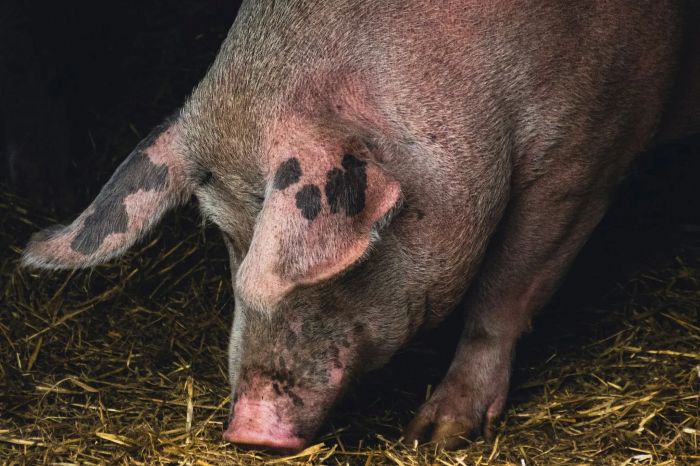
This was the last year Henry would kill the pig. Henry told me so herself, standing on the porch, looking left from the door to the field. It was the first thing any of the Laurensons said that afternoon, after they turned up 40 minutes late. They always talked about it that way, “the pig,” like it was the same one they killed every time.
When Henry folded her arms I saw her ribs move. “I’ll be at uni next year. I’m not coming back for it. And I’ll be eighteen anyway, so he won’t be able to make me do anything anymore.”
Eleanor, Henry’s middle sister, leaned against the porch’s brick pillar, looking at her phone. The youngest, Clementine, stood on the drive beside her dad, clutching the wellies he was passing her from the Land Rover against her chest. His boots were as long as her torso. When she had all eight Matthew shut the car and looked at me, flat-mouthed.
“Come in,” I said. Henry gave me a formal smile and disappeared towards the kitchen. Eleanor followed. Clementine crossed the gravel and dropped the boots beside the door. Matthew kissed the air next to my ear.
“Jessie,” he said. “Ignore my eldest. I do these days.”
Clementine dusted her hands on each other. “Henry’s taken her acting lessons rather to heart. Teenagers are like that.”
I pushed the door closed behind them. “You’ll be one in three years,” I said.
Her face was serious. “I’llnever be like her.”
In the kitchen I made tea and set the mugs on the table. Matthew leaned against the counter, feet crossed at the ankles. He told Eleanor to put her phone down. She placed it screen-up in front of her and continued to scroll. He exhaled. “Where’s your husband, Jessie?”
“Checking feed.”
“Oh — ” The vowel went up like he meant to continue, but he only looked into the utility room. A pile of dirty darks lay in front of the washing machine.
“How are the new arcs?” Clementine asked. “I told Dad skimping on something like that was a false economy, but he wouldn’t be swayed.” She leaned forward on the table, her hands clasped in front of her chest.
“They’re fine,” I said.
“Good. And the change from the barley bedding to the wheat hasn’t caused any problems?”
“None so far.”
“Super.”
I sipped. Henry frowned at a chip on her mug and then turned to the sink, where the plates and pans from breakfast lay still smeared in oil and egg. Her eyes moved up to the window. The branches of two oaks drifted against the October grey, the roof of the finishing shed just visible between them.
“It’s a sad day,” she said.
“Don’t,” Matthew said.
Henry looked at her dad and then at me. She laid a hand at the base of her throat, bony fingers splayed. “I don’t eat meat anymore, Jessie. So I don’t really understand why I’m expected to be here.”
“Because your rabbit food is paid for with money that comes from our farms,” Matthew said. He sat down at the table, pulling the last mug towards him and lifting it to his chin. “So unless you’re going to start shopping and cooking for yourself I suggest you stop moaning.”
“You said the farms don’t make any money — ”
“You don’t know anything about that subject — ”
“And I could, anyway, next year I’ll be doing all my own — ”
“Henrietta, shut up.” Matthew brought the mug down hard on the table and the handle broke off in his fingers.
Eleanor looked up. Her hair had grown in the last year, and it hung around her face, making her features look smaller and less defined. I had the same feeling I got when I saw a gilt with an injured leg. I wanted to put her out of her misery.
When Matthew was married to Effie, the two of them always arrived on time. Matthew explained to Nick and me that the annual visits were part of the Laurenson Pork philosophy. “Hands-on,” he said, and then laughed. “Sort of. My grandfather moved all the Laurensons into London so it’s kind of hands-on-from-a-distance. Really long arms, you could say.”
Nick and I laughed too, because Matthew expected it. We were newlyweds then. My parents had sold their farm and bought a village shop, and Nick’s had died and left all their land to his sister. She would have shared it with him, if he’d asked her to, but he wouldn’t. We were saving for our own. In the meantime the pay for running Redbury was decent, and the risk was all Matthew’s. His real money was in property, of course.
We knew Matthew and Effie had two small girls, and later three, but they turned up the first time alone. Matthew acted as I expected, slapping the sides of the sheds and praising their solidity, offering useless suggestions about storage. But Effie was smart. She asked good questions about effects of the weather on feed quality, got down on her hands and knees to look inside a damaged farrowing arc. In the nursery she pointed out a sore patch we hadn’t noticed on one barrow’s side. Nick brought the ointment and she rubbed it in herself.
Three years later, when we heard that Effie had left Matthew, I was more annoyed than seemed reasonable. I felt like she’d broken a deal.
We stood on the drive to receive Matthew as usual the year after Effie’s departure. He got out first, and then opened the backseat and lifted a three-year-old Clementine onto the gravel. Eleanor, then seven, was next, and finally Henry, who at 10 had clip-on earrings turning each of her lobes pink.
We took the Laurensons into the kitchen for tea and then gave them the tour. No one mentioned Effie. In the finishing shed Henry shut two fingers over her nose. Eleanor raised her shoulders around her ears. Clementine, on Nick’s hip, put her thumb in her mouth and scanned the pigs with narrowed eyes.
Matthew leaned over a railing, watching a gilt with a black mark in the shape of a leaf on her right side. He’d been silent the whole afternoon. Now, without looking away, he asked: “Your grandfather used to butcher a pig for the family at Christmas, didn’t he, Nick? Didn’t you tell me that?”
Nick, behind me, was tickling Clementine’s chin with a strand of hay. She pushed it away. “Most years, yeah,” he said. “I’m not sure it was ever an expert method but he knew his way around.”
Matthew scratched the side of his jaw. “Any chance you have his old tools?”
“Somewhere. Knackered things now, though.”
“They don’t stop working, do they?”
“Not if they’re any good.”
Matthew leaned further into the pen. “So we could do it?”
The gilt swished her tail. Nick looked at me and I moved my head an inch in either direction. When the pause grew too long Matthew turned around.
“No?”
At the far end of the shed two barrows squealed.
“You really need to starve a pig twenty-four hours before slaughter,” Nick said. “Makes gutting easier.”
“They can’t do that in the wild.”
“This isn’t the wild,” I said.
Matthew looked at me like he’d forgotten I was there, and then turned back to Nick and nodded. “Let’s do it.”
“You’re meant to tell the council if you’re doing home slaughter,” I said. “It might not be safe.”
Eleanor and Henry were watching me but Matthew kept looking at my husband.
“It’s a waste of revenue,” I tried.
Matthew’s mouth was a little open, the points of his canines just visible in the surrounding darkness.
“They’re my pigs, Jessie,” he said.
Henry shot the first pig in the head with our .22 rifle, and then Nick held its right foreleg up, his legs over its back, and guided Matthew’s knife into its throat to sever the aorta. I stood back with Eleanor and Clementine while we waited for the animal to finish bleeding onto the grass. Beside it was a laminated tablecloth, daisy-print, ready for the carcass to be laid out.
After a minute of watching it twitch Henry wandered over to me and sat down on the ground. “Do you and Nick have children?” she asked.
Eleanor squatted next to her and put her hands on her forehead. Clementine pulled at my arm, straining towards her dad.
“No,” I said.
“Why not?”
“Not everyone has children.”
I expected her to tell me that wasn’t a real answer. Instead she said: “Our piano teacher says children have no morality.” She gazed at the puddle of blood. “Do pigs have morality?”
I handed Clementine a stick, which she examined for a moment and then snapped in two.
“I suppose not,” I said.
Eleanor stood up, said she felt dizzy, and then vomited onto the grass.
I gave Eleanor a glass of water inside and sat her in front of Friends. The colour slowly returned to her face. Halfway through the second episode Nick appeared in the doorway.
“Matthew wants me to bring her back out,” he said, after waving me over. He was wearing the apron he usually wore to cook.
“You’ll have to throw that away,” I said.
“I know.” Eleanor laughed at the TV. Nick nodded at her. “Let’s go.”
“She’ll faint. Tell him to let her stay here.”
“He wants them to learn a life skill.”
I felt my jaw move. “What circumstances in these girls’ lives would require them to butcher their own animal? It’s for fun. And this one’s not having any.”
Nick tilted his head. “It’s not worth pissing him off over, is it?”
I felt an urge to dab a finger into the wet blood on the apron’s front pocket. I could smell the pig on the fabric, as strongly as if she’d been in the room.
“Ellie,” Nick called over my shoulder. “Your dad wants you to help us. Come on.”
I turned around. Eleanor’s head was still facing forward, but her focus had slipped down to the carpet below the TV. She gave the sofa cushion two slow pats with her right hand and then got up and came to the door.
The sponges Henry and Matthew were using to wash the carcass had turned brown. Nick held Clementine again as he directed them, her head now resting on his shoulder. Eleanor chewed her hair. When Matthew called her over to handle the incision to the hind leg, she went.
Nick said the pig should be hung for skinning and gutting, so he and Matthew wrapped it in the tablecloth and carried it together to the tractor shed. Nick fashioned a hoist from a length of rope and looped it over a rafter, tying the other end to his grandfather’s gambrel. I watched the muscles in his back move as he and Matthew pulled the weight up.
Matthew stood on a stepladder to slice away the connective tissue, handing the knife to Henry or Eleanor when there was an easy cut. When the guts dropped onto the tarp Nick had laid there was a wet thud.
“Do you want that?” Nick asked Matthew. He looked for a clean place on his apron to wipe his hands. “Makes good sausages. The heart and that can go in dog food.”
Matthew had made a display of frankness about the pig up until that point, but for just a second I saw him look away.
“I’ll get the wheelbarrow to burn it,” I said.
“We should use it,” Nick said.
“We don’t have any dogs.”
Nick looked at me. We both knew we had a meat grinder, in the cupboard above the oven, and that I usually hated wasting food. I held his gaze. He blinked and then gave a small nod. Matthew touched his forehead with the back of his wrist.
When I came back with the bags Henry was kneeling beside the guts with Clementine, studying their contents. Eleanor stood on the stepladder above them, sawing the skinned pig down the middle. Sweat shone on her cheeks.
It was after four by the time it was done. We stood and surveyed the two halves, listening to the rustle of leaves outside. Matthew put his hands on his hips, folded his arms, tucked his thumbs in his belt-loops. Instead of satisfied his face was taut.
“It can hang for a few days, assuming we don’t get a heatwave,” said Nick. “Come back next week and we’ll have a good dinner.”
Matthew nodded. A spatter of blood had dried, solid and black, on the chest of his blue button-down.
At the house Matthew took a long time in the bathroom. He came out smelling of lavender hand soap and told Eleanor and Henry to go and wash up.
I stood by the window, watching Nick wheel the offal across the yard. Matthew sat down with Clementine on his lap and took out his phone.
“Do you still want lunch?” I asked, without turning around. “It’s chicken pie and potatoes.”
“No, no,” he said. “I have to get back to town.”
He didn’t wait to say goodbye to Nick. The girls came down, and in 30 seconds the four of them had piled into the Land Rover and pulled away for London. Nick phoned him a week later to ask when he was going to collect the meat. Matthew told him to keep it.
I watched the Laurensons climb out of the car the following October and hoped that whatever had possessed Matthew 12 months before was gone. But at the end of the tour he squatted down in front of Henry and said: “That was great fun with the pig last year, wasn’t it? Shall we do it again?”
Henry smiled. The headphone in her right ear leaked tinny guitars.
Half an hour later another tablecloth was laid out in the field behind the grain shed, this time blue check. Eleanor watched the shooting with a crease between her eyebrows. When the blood spurted from the gilt’s throat Clementine laughed.
“She doesn’t understand,” I said to Matthew, taking his four-year-old’s hand.
He was wiping his knife on the grass and ignored me. It was Henry who answered. “She does.”
I did keep the guts that second time. I visited a butcher friend for advice on how to use the parts I knew less well. When I explained it all, standing in the alley at the back of his shop, he snorted.
“These people.” He licked the seam of the cigarette he was rolling. “All they want is to get their hands dirty.”
Matthew didn’t bother requesting to kill the pig the third year. Before we started the tour he laid a palm on Nick’s shoulder and asked if he had the tools ready. He’d gained weight and was in a good mood. I could see him squeezing Nick’s skin.
“Do you think Matthew kills a pig on all his farms?” I asked Nick from the bath that night. “Or is it just ours?”
Nick spat pink-tinged toothpaste into the sink. “Nicole at Greenview called me after he visited them last month and said he was weirdly cheerful, but that was all.”
“Do you think killing pigs makes him cheerful?”
“Does it matter?”
“Sort of, yeah.”
“Bleeding heart for the ham.” He rinsed away the toothpaste and sat on the toilet seat lid. “If he only does it at our farm that means he feels comfortable with us. That’s a good thing. The pigs are for it anyway, Jess.”
“For food. Not for entertainment.”
“Makes no difference to the pig, does it?”
I struggled to flick the hot tap with my toe. Nick got up and turned it for me.
“Did you say anything to Nicole about it?” I asked.
Nick looked at my legs in the water. “No.”
“Why?”
I knew why. At least, I knew the feeling that I wouldn’t have told Nicole either, and that maybe Nicole wouldn’t tell us. But I wanted to hear Nick explain it.
Nick touched the water and then turned off the tap. “It feels personal,” he said.
The fourth year Matthew dispensed with the idea that he was there to do anything other than kill the pig. On the doorstep he air-kissed me and said, “I’ve got to be back in town early for something important. So if it’s alright with you we’ll skip to the main event.”
For her 13th birthday Henry had had her ears pierced. Matthew announced that now she was a grown-up it was her turn to stick the pig’s throat. Eleanor inherited the rifle and fired with her eyes closed. Clementine had started wearing glasses, and when the animal was dropped by Nick and Matthew onto the tablecloth — green fern leaves — I noticed their lenses were misty.
Later, while Matthew was washing his hands, Henry leaned across the kitchen table to me. “He’s got a date. That’s why he wants to get back.”
“Is that right?”
She nodded and her new hoops swung. “She wants him to propose.”
Eleanor held her mug up to her mouth with both hands. “She’s never said that.”
“You might think she’s never said anything about you, either, but that’s because I choose not to repeat it.”
Eleanor averted her gaze from her sister’s face. Matthew came back into the room, cheeks pink, and slapped his middle daughter on the back.
“So serious in here,” he said. “Come on ladies. I have wine to buy.”
In June of the fifth year my dad called to say my mum was sick: ovarian cancer, well advanced. By late September she was in the hospice. Nicole from Greenview said she and her husband would cover Redbury for as long as Nick and I needed.
I called Matthew to tell him we’d have to postpone his visit. I expected a quick, functional conversation, but when I stopped speaking there was silence. After a few seconds I heard a damp sound, like Matthew was licking his lips.
“Won’t Nick be there?” he asked slowly.
“Nick’s coming with me,” I said.
“Is that necessary?”
“If my mum dies I’d like to have my husband there, yes.”
“Oh, I understand that for the funeral. But — I’m sorry if this is crude, but it might be weeks, mightn’t it?”
“It doesn’t look like it,” I said, and smacked the palm of my hand hard against the bedroom wall.
“Well, it never does. But old people are hardier than you think. My father was almost dead for six years.” He laughed through closed lips. “I’m also a little — a little concerned. About the proposed time off. There are already some inefficiencies I’ve noticed at Redbury.”
I balled the stinging hand into a fist. “You’ve never mentioned inefficiencies before.”
“Well, I try not to make a point of criticism,” Matthew said. “But if you and Nick are going to insist on making snap decisions, that could become harder. It’s a question of practicality, Jessie.”
Nick arrived at my parents’ house three hours before my mum’s funeral. In bed that night, in the dark, he told me Matthew had turned up with his own butchery set in a leather roll bag engraved “MJL.” He’d said to Henry she could pick out the pig. The 14-year-old took a long time to deliberate and then chose a barrow with a white ring around one foreleg.
I told Nick the following October that I was going on a trip to see some old school friends. When he pointed out that my dates clashed with Matthew’s visit, I said, “Yes.”
I was sitting at the kitchen table with my laptop open. I kept my eyes moving across the screen. Nick ran the tap and drank a glass of water and then sat down opposite me.
“This time only,” he said.
I didn’t wait on the drive for the Laurensons to arrive the seventh year, or prepare lunch, or tidy the farmhouse. I got on with my work until I heard the doorbell and then kept at it so they had to ring again.
Matthew glanced at my stained clothes when I opened the door and gave me an uncertain smile. Clementine followed him down the hall, his leather bag held in front of her. Eleanor went next, scratching her head. I could see flakes of dandruff in the parting. Henry told me to leave the door open, sat down on the step, and lit a thin cigarette.
Nick had told me about Matthew’s engagement the previous year, and as we walked down to the finishing shed I saw him slip a gold band off his finger and into his pocket. I didn’t ask why his new wife wasn’t there. I didn’t say anything that wasn’t required. Henry, though, standing over the bleeding pig an hour later, looked up at her father. “Couldn’t stomach it, could she?”
Matthew considered the sharpness of his handsaw. “Let’s not, Hen.”
Henry turned to Nick beside her. “Our stepmother eats meat but can’t face killing an animal. It’s so unprincipled.”
“Most people are like that,” Clementine said.
The three girls had it down between them now: the youngest with the gun, the oldest with the knife, the middle holding the pig’s forelegs open for access. The adults stood back and watched.
“Most people are shit and selfish,” Henry said.
“It seems more selfish not to eat something if it’s already dead,” Eleanor said.
“She’s not being logical, Ellie,” Clementine said. “Don’t worry about it.”
“I’m not worried,” Eleanor said.
“Be quiet, Eleanor.” Matthew gestured at Nick with the saw. “Let’s get on with it.”
There was something strained in Matthew that day. In the shed later, when he punctured the stomach, spilling acid across the hanging barrow’s lower half, it snapped. He turned to Nick, waving his knife above his head.
“What’s the point of us driving all the way here from fucking London if we’re just going to fuck it up? What is the point?”
Nick put his hands in his pockets. In the two years I’d missed, I realised, whatever entertainment he’d once got out of the Laurensons had dried up. The rafter with the gambrel attached creaked.
“Matthew,” Nick said. “No one asks you to do this.”
Matthew breathed through his open mouth. “Go back to the house. We know how it works now. We don’t need you.”
Nick turned and did as he was told. I went to follow, but then Eleanor looked at me, and for her sake or the pig’s, I stayed.
As they filed back out to the car that afternoon, Eleanor paused beside me and sniffed.
“Let’s kill him next year,” she said.
I smiled. I let myself stroke her hair, running my palm from the white-flaked centre to its blunt ends. “Deal.”
On the eighth year Matthew laid the broken handle carefully beside the mug, and then stood and said, “I’ll get the boots.”
Nick had told me that morning he wouldn’t be joining us. When I argued he leaned down and pushed away a piglet nosing the knee of his jeans. “I gave you a year off,” he said. “It’s my turn.”
Clementine got to choose the pig this time. Matthew said she was the only one of the three girls who took the task seriously. She walked four lengths of the finishing shed and then pointed at the biggest gilt of the herd.
I hooked the wire rope loop past the gilt’s ears and tried to lead her out into the run, but she stayed focused on her food. The Laurensons watched me, Henry with one foot up on the pen fence’s first rung.
“Smack the hams,” Clementine said.
I straightened. “Pick another. She’s too strong.”
She looked amused. “But I want her.”
Matthew touched his youngest daughter’s head. His leather pouch was under his arm. “Don’t we have one of those electric prods, Jessie?”
I handed the wire to Matthew and went to get the sorting board. When I came back Henry was in the pen pulling hard on the loop. Clementine stood behind her, slapping the same spot on the gilt’s back over and over again.
I put my elbow on the top rung and rested my head in my hand. “She won’t come forward while you’re standing in her way,” I said to Henry. “And if she gets stressed out she’ll bite you.”
Henry dropped the wire on the floor. “I’m just trying to get this barbarity over with as quickly as possible.”
On the other side of the run Eleanor chewed a cuticle. I waved Henry out of the way. “Matthew, take the wire. Don’t drag her,” I said, raising the board. “Just hold on.”
We wrangled the pig. In the shed she had brushed at Clementine’s hands like they were flies. By the time we reached the field she was anxious, squealing, turning quickly from side to side. Twice she raised her tail and dropped thin black streams of shit. I wanted to send Clementine to get Nick, but she had already picked up the gun and aimed it at the centre of the head.
“Loose her,” I said to Matthew, looking at the barrel pointing too directly towards his torso.
“She’ll run off,” he said.
“Then let her run off. This isn’t fair.”
Matthew glared at me and passed the wire off to Henry, who gripped its base with both hands. She contorted herself to keep control over the pig without getting in the way of the gun. Matthew stood back beside Eleanor on the grass, opening his tools and handing her the sharpest knife. I saw the steel of it glint.
The next cry was human. I turned. The gilt spotted the open space and bolted down towards the stream. The wire yanked out of Henry’s hands and she was flipped onto the muck-covered ground. Clementine dropped the gun. The bullet sliced a valley through the grass.
Eleanor was still holding the handle of the knife, which was sticking out of her father’s stomach. Those small eyes bulged.
Henry screamed. Matthew dropped to the ground.
Just after New Year’s Nick and I decided we had saved enough money to buy our own land. We hadn’t, really, but we colluded in the lie.
I told Nick he’d better call Matthew with our notice and went out to check on the boars. Five minutes later Nick jogged up to me with the phone and said Matthew wanted to talk.
The voice on the other end had a brittle cheerfulness. Matthew spoke unprompted for a while about the diminishing profitability of the pork business and said perhaps he should stop losing money to nostalgia. I hummed in response. He cleared his throat and changed the subject to his stomach. “Hurts like hell when it’s cold. But my wife likes the scar.”
“Are the girls alright?” I asked.
“Oh, fine. If the results are what we hope for Henry’s off to Exeter in September. Clementine has been on a sailing camp this week in the Canary Islands. And Eleanor’s been getting some — some support.”
I heard him swallow and wondered which part of October he was remembering: Clementine howling that her sister was going to prison, going there for life, Henry’s ringed fingers flitting over his torso as she tried to force herself to press on the wound, or Eleanor, where she had simply sat down on the grass and cried. Until we moved her, her streaming eyes stayed fixed on the pig, who had slowed her run at the end of the field and then turned and stood, watching Eleanor back.
Nick drove the four of them to the hospital. He told me later that when Eleanor stopped crying, she’d stopped speaking as well. The last he’d seen of her she’d been silent in a chair beside Matthew’s bedside while Matthew explained to two police officers that it was just a terrible accident, clumsy city kids with butchery equipment, everything was fine.
When Matthew next spoke his tone was serious. “I wanted them to see a bit of reality, you know, Jessie. To understand not everything comes paid-for and pre-packaged. Sometimes in life there’s blood and gore. It was the right thing, wasn’t it? You think so?”
I noticed the boar near me had a piece of bedding stuck to his side and pulled it off.
“They’re your kids, Matthew,” I said.

Francesca Newton is a writer and editor based in London. Her writing has appeared in The Nation, The Baffler, The Guardian, and other outlets. She previously worked at Tribune Magazine and contributes to Vashti Media.