

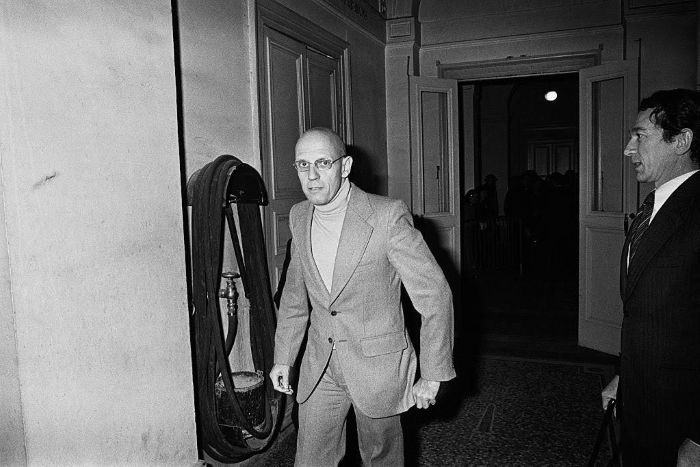
In The Frenchmen, her new chronicle of postwar French philosophy, New York Times Book Review senior editor Emily Eakin has done something truly impressive, arranging some of the most brilliant but bilious figures of late-20th-century continental thought into a narrative that is lively and informative, never pretentious and never dull.
That’s an achievement that every work of nonfiction should strive for, but it is especially notable because the Frenchmen whom Eakin writes about frequently were, themselves, dull and pretentious. One of them, Louis Althusser, killed his wife. Paul de Man wrote pro-Nazi articles during World War II. Jacques Lacan slept with his psychoanalysis patients. Their acolytes in the United States were, for the most part, better behaved but much more boring, their work devolving into the very puritanism they were trying to escape. But say what you will about Eakin’s subjects, they weren’t just bullshitting in their Paris apartments and École Normale Supérieure classrooms. They were fomenting a revolution, minus, for the most part, the Molotov cocktails.
Eakin fell in love with French theory as an undergraduate at Harvard in the 1980s, where her friends included A. O. Scott, today a celebrated New York Times movie and book critic, and Mark McGurl, now a professor of English at Stanford. Arriving in Cambridge, she describes her attraction to French theory in disarmingly earnest terms: “Theory made thinking feel like doing. There was a rigor and beauty to it, an athletic strenuousness.”
Michel Foucault, one of the main characters in The Frenchmen, to say nothing of his role as bête noire to today’s cultural right, might have observed that Eakin was engaging in what he would call “practices of the self” — that is, selfhood as an intellectual and experiential exercise that alchemizes knowledge into freedom. Her education took place at a time when colleges were orienting themselves decisively toward corporate finance and high technology: “Traditional financial businesses are the only things that are talked about much,” one student said of career counseling at Harvard for a 1993 story in the Harvard Crimson.
She frames her and others’ interest in French theory as a natural response to the neoliberal project foisted on the Western world by Ronald Reagan and Margaret Thatcher. She quotes Fredric Jameson, the late Duke theorist: “What appeared when the dust settled, when the fog of war cleared away, was not a transformed world, not even the world of decolonization, of independent nations, but the world of transnational corporations, nascent globalization.” Beneath the paving stones, the Salomon Brothers trading floor.
The poststructuralists (Foucault, but also Claude Lévi-Strauss and Roland Barthes) and deconstructionists (Paul de Man, Jacques Derrida) wanted to understand how power relations had formed. Perhaps that understanding was the first step of a dismantling or, if that was impossible, at least a personal liberation. “The critique of language elaborated by the Frenchmen,” Eakin writes, cemented the notions that “discourse conditions our experience of reality, including of ourselves” and that “meaning is never stable or fixed.” If those principles seem obvious today, it is only because these Frenchmen devoted their lives to making it so.
While prewar philosophy had been focused on metaphysical questions (the nature of truth, the problem of evil), theory was occupied with language: what it does, what it evades, whom it recognizes, whom it leaves out. “The dawning awareness of language’s determinative unstable force understandably generates as much apprehension as incitement,” Eakin writes. “If we can control the language, the thinking goes, we can better control the people.”
Eakin’s narrative starts with Jean-Paul Sartre, whose existentialism laid the foundation for later thinkers who would stress radical subjectivity as the starting point of understanding. Devoting entire chapters to Marxists like Louis Althusser and post-Freudians like Jacques Lacan may seem like a risky enterprise in this great TikTok age of ours, yet Eakin manages to limn their work with a light touch. Foucault is “a philosopher, not a militant”; Roland Barthes “presented the world as a narrative in perpetual flux, forming and reforming beneath the reader’s gaze.” I wish I’d had these pithy insights when I was hacking my way through Lacan’s “The Mirror Stage” during my own college days.
In a thoroughly lively and generally positive review for the New Yorker, Dayna Tortorici dinged Eakin for the “journalistic plainspokenness” of her prose. “The book’s appeals to reader-friendliness can feel pandering,” Tortorici writes. It’s not an unfair criticism. But when the bestselling nonfiction book on Amazon is Protocols: An Operating Manual for the Human Body, by Andrew Huberman, with Mel Robbins’ dismayingly viral The Let Them Theory not far behind, I don’t know that turning Jacques Derrida’s close-to-incomprehensible Of Grammatology into something a normal human being can digest is all that much of a crime. In fact, I’d argue very much the opposite.
In the years since Eakin graduated from college, higher education has become much more transactional. It has also become much more expensive, a not-unrelated phenomenon. If you’re going to shell out $100,000 per year for school, it is perfectly reasonable to expect that the terminus of all that learning is a partnership at Hogan Lovells and a four-bedroom colonial in Montclair.
The Frenchmen is not a sales pitch, however. Eakin details her own painful disenchantment with theory. She was working for the magazine Lingua Franca in 1996 when it published the academic scoop of the decade: the theory journal Social Text had published a paper by the mathematician and physicist Alan Sokal titled “Transgressing the Boundaries: Toward a Transformative Hermeneutics of Quantum Gravity.”
There was only one problem: the paper was, as Lingua Franca revealed, a hoax. You can practically hear Sokal laughing as he writes lines like this:
One characteristic of the emerging postmodern science is its stress on nonlinearity and discontinuity: this is evident, for example, in chaos theory and the theory of phase transitions as well as in quantum gravity. At the same time, feminist thinkers have pointed out the need for an adequate analysis of fluidity, in particular turbulent fluidity.
Three years later, the philosopher Martha Nussbaum delivered a devastating blow to Judith Butler, one of America’s most notorious practitioners of theory. That review, titled “The Professor of Parody,” ran in the New Republic, a sign of how much traction theory had gained in mainstream culture, or what remained thereof. Nussbaum observed that, in Butler’s writing, “Obscurity creates an aura of importance,” disguising “an absence of a real complexity of thought and argument.” While that was (and remains) true of Butler’s sententious and slipshod output, the very same could be said of Homi Bhabha, Avital Ronell, and many others. Nussbaum was writing about a movement, not a person.
Eakin was becoming disenchanted, too. “As practiced by many Americans, theory had turned inward on itself, becoming less focused on a recognizable social world and more of a kind of aesthetic pose.” It is indeed a tragedy that the high-minded incoherence of Butler et al. discredited a movement that never belonged to her and her ilk to begin with.
In fact, from the viewpoint of 2026, it is hard to read, say, Foucault’s Discipline and Punish and not see a profoundly prophetic work. It is also worth noting that the intellectual habits of theory are even more valuable than its conclusions.
“Maybe theory didn’t teach us how to live with ease, but it taught us a new way to think. Be skeptical. Be alert. Pay very close attention,” Eakin writes. Get woke, in other words. And stay woke. How does that go in French?

Alexander Nazaryan writes about culture, politics, and science.