

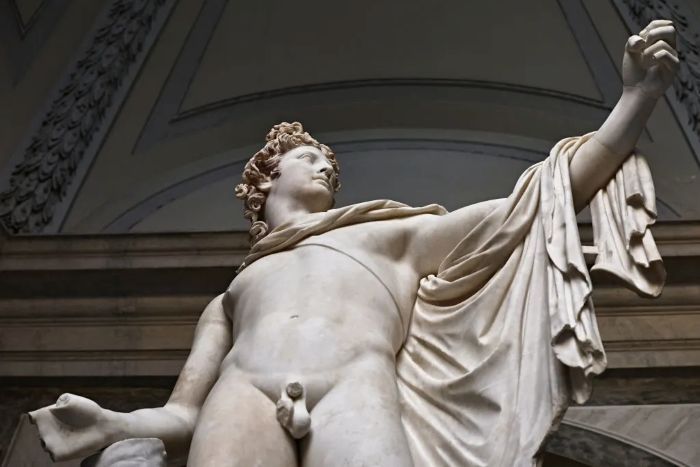
Desire, desire. From the Grecian marbles to Grindr, human endeavor has been desire’s dancing monkey. And now the fetid frustrations of centuries of artists have found their conduit in the pigeon-chested, speccy, psychotically horny Dr. Hugh Clore. The villain narrator of British author Ben Sims’ debut novel The Long Let renders himself and his quest for his beloved 20-year-old orphaned landlord in such oleaginous prose, the book makes a fool of the dignity we assume art confers on desire. With an approach to prose as liberal as the polyester-shirted wheeler-dealer’s to cologne, voice overpowers plot in this masterful debut where lustful psychosis wills a moment to its crisis.
So to style. No review of The Long Let has bypassed style, and this will be no exception. As a professor of English at King’s College, Dr. Hugh Clore is versed in the European canon in the vein of the sweeping undergraduate who likes to be seen reading Shelley in a coffee shop. Clore sits there pretending to read hefty literary tomes, the tomes in his lap really concealing the hard-on he bears for 20-year-old Arthur upstairs. He’s an academic writing a paper titled, “On First Looking into Chapman’s Bussy,” twisting Keats’ “On First Looking into Chapman’s Homer.” His supposed scholarship becomes another vehicle for sexual innuendo. We don’t believe in him as a serious academic, but his background arms him with an excessively erudite palette for his obsession. A perfume ad inspired by the Old Masters.
Arthur is not, as is plain to the reader, just a normal dope-smoking, unemployed gym bro, but to Clore he’s Michelangelo’s or Donatello’s David, Shakespeare’s Fair Youth, or even, at one point, Christ. Nothing can convince Clore to the contrary. The real Arthur becomes a foil for Clore’s Platonic Arthur, showing us an obsession which has little basis in the object of his desire, a great strength in a novel that unseats the narrator almost from the off. And sure, Hugh Clore is a demented monomaniac, but as art has reiterated over centuries, desire can have that effect. To the last pubic hair, no detail is left ungilded in his mimesis. And maybe this would get boring if Sims wasn’t such a gifted sensualist. In typical hyperbole, Arthur’s sweat has a “smell of floodlights in rain, spores, cuprous richness, salt flats, horse hide, and a subtle, unidentifiable floating note, squillo withheld, a mere tremulous pianissimo.”
His desire lies somewhere between synesthesia and schizophrenia; the closer he gets, the wilder his rhapsodies. Each encounter has the feeling of being slowed down, every detail acquiring a psychedelic clarity, as in the moment before a fatal crash.
These passages deepen our dread, reading as horror, rather than artful appreciation of the male form. We learn on the first page that Arthur has very recently been orphaned in a tragic car accident and this is the reason he has taken a lodger. Arthur’s grief, which has surely upended his life, barely registers in Clore’s account. His exquisite sensitivity to the boy’s body makes his indifference to his suffering all the more chilling. The horror lies in this gulf between how closely Arthur is observed and how little he is understood. It is in what escapes Clore’s attention that Sims makes his presence felt.
Critics who note the prose’s icky purpleness miss the point. Of course Dr. Hugh Clore reeks. When, at one point, he invites a homeless man in for Christmas dinner, we are not surprised to see him turned down. The prose is propelled by a cankerous desire that leeches and swells off Arthur, even evidence of his ambivalence. Endless ekphrasis runs away with itself, reflected in careening, unstabilized rhythms that pitch the book into higher pitches of frustration. The reader’s joy is in finding Clore’s own stylistic project thwarted. One such passage ends with a jolt, “I imagined too hard.” Aesthetic contemplation cannot sustain our narrator indefinitely. His escalating acts of covert physical gratification expose the acquisitive appetite beneath his scholarly reverence.
References to hard-ons, ejaculation, wanking, Tinder, and Grindr hook-ups feel anachronistic to such lofty baroque. The novel operates on several of these uncanny, logical inconsistencies. The townhouse in Highbury is drawn in the creaking, drafty gloom of a much earlier period. The novel’s three characters — Clore, Arthur, and Arthur’s girlfriend Georgia — maintain harmony despite aggressive confrontations which would in any other circumstance result in Clore being ejected from the house. Clore’s extravagant outgoings on rent and a diet of fin-de-siècle decadence despite financial constraints. The practical arrangements are as precarious as the emotional ones. We do not believe Hugh Clore’s house of cards will last the night.
So Dr. Hugh Clore is a character who does not wear his learning lightly, but knows almost nothing about the world around him. There’s a hilarious passage in which Hugh orders Arthur flowers.
Here I was, ordering flowers to be delivered, I assumed by a liveried footman, with my notecard, printed on thick cream paper. . . . I found peonies, weak flowers, effete, pink and massy, a pale watercolour-wash merely, recalling the still lifes of Nicholson and Fantin Latour, and which were therefore of our era, Arthur’s and mine, the decadence of the fin de siecle, a time of poets and pederasts, of novels and ease. They’d arrive at noon.
The imagined liveried footman and thick cream paper belong to Hugh’s private period drama. To cast this Jordan Peterson-reading, Huel-guzzling, FIFA-playing youth as a fellow spirit of the fin de siècle is laughable. The peonies tell us everything about Hugh’s taste and nothing about Arthur’s. And then Arthur scuppers the delivery scene Hugh has scripted with a simple announcement, “I was gonna go gym.” Their one-sided romance repeatedly founders on this bathos: Hugh supplies the aesthetic rapture; Arthur has other plans. Hugh doesn’t give a fig what Arthur wants, only how he might feature in Hugh’s fantasy. These collisions between grandiloquent language and resolutely ordinary life tip the prose from the operatic into camp.
Speech: speech that is faithful to the way we speak in this day and age is used throughout to stymie Hugh’s rhapsodies. When Hugh plots to catfish Arthur on Tinder as a hot girl, he admires his handiwork on the profile: “Michelangelo must have felt the same stepping back to look over finished form of a marble Madonna.” And then we hear Arthur’s verdict, “Spice, yeah.” Beneath the grandiloquence, Sims is doing something more exact with narrative form. Lavish paragraphs are punctured with two normal, grounded words. The imbalance is comic, but it also exposes the limits of Hugh’s control. He commands the descriptions, while the dialogue reasserts that he is living in a more exaggerated fiction.
In these intrusions we sense that Hugh is not quite as firmly in control of the narrative as he believes. This in Georgia Groad, Arthur’s girlfriend, who appears at the breakfast table one morning. When Hugh later objects to finding a woman in “my kitchen,” she corrects him: “Arthur’s.” His proprietary fantasy collapses into the fact of his tenancy. She is equally sharp about his academic authority. When he abandons a lesson because she dislikes Joyce’s “The Dead,” she asks, “It’s not infantile to have a tantrum when someone disagrees with you?” His defense amounts to “Because it’s a masterpiece. Part of the Western canon. By James fucking Joyce.” Georgia’s answer — “So teach me why you like it then” — is a reasonable request that his account cannot make unreasonable. Like Dorian’s treatment of Sibyl Vane in Oscar Wilde’s The Picture of Dorian Gray, Hugh’s contempt for her exposes the cruelty that can accompany a cultivated devotion to beauty. Georgia is the intrusive woman in Hugh’s imagined gay romance, and a grounding corrective in Sims’ psychological thriller.
The plot receives less attention than the prose, and here the novel’s priorities become more troubling. Hugh’s connection to Arthur’s parents, and the possibility of his involvement in their deaths, underpin the thriller, promising to recast his tenancy and obsession in a more sinister light. Yet the ending gives this revelation little room to register before violence and narrative revisions take over. Its consequences for Arthur go largely unexplored. His grief, previously obscured by Hugh’s self-absorption, now seems obscured by the novel’s construction. What worked as an indictment of the narrator becomes a weakness in the book. Arthur remains exquisitely available to description, while the family tragedy on which the thriller rests scarcely acquires an emotional life beyond Hugh’s telling.
Georgia’s most damaging challenge is to Hugh’s intellectual authority: “I’d been doing better in my exams up till now, i.e. up till when you’ve been tutoring me.” His learning, supposedly offered for her benefit, has become another indulgence at her expense. When she cries “we tried so hard,” he privately recoils: “We did not get a two-two, seeing as I took my (excellent) degree decades before the conversation occurred.” That parenthetical “excellent” is Hugh in miniature: even someone else’s disappointment must make room for his distinction. What, then, has all this cultivation cultivated? A life spent on Caravaggio and Cézanne, Schubert, Keats, Lawrence, and Tennyson has rarely seemed so extravagantly self-serving.
Hugh is an uncomfortable figure to encounter amid the contraction of British humanities departments. Yet the literary intelligence he uses to excuse himself is also how Sims exposes him. Distrust of Hugh’s authority makes us read more closely, testing his elaborate judgments against Georgia’s questions and Arthur’s ordinary replies. Hugh is a dreadful advertisement for the humanities; the pleasure of Sims’ stylistic genius reminds us why we bother.

Lauren Sneade is a culture writer from London. She has written character-led narrative features for The Guardian, New Statesman and The Fence, and short fiction on Substack. She is working on her debut novel.