

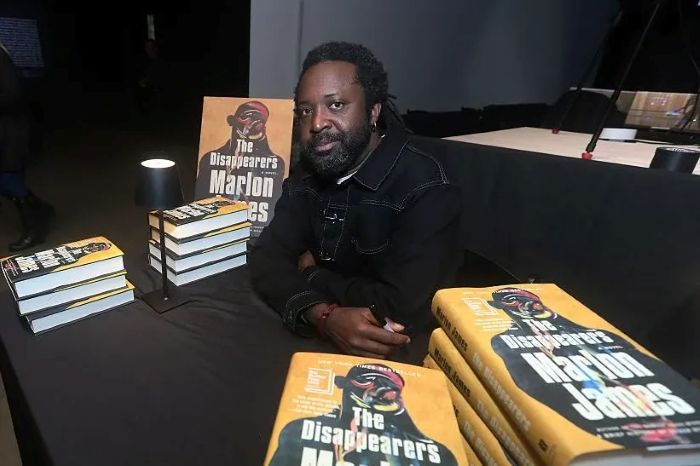
At the tail end of summer, Dwight Garner accomplished what few legacy media critics have since the days of Michiko Kakutani: he wrote a review that helped sell a book. A literary novel of more than 600 pages, no less. It was a conservative first printing. At 37,000 copies, Riverhead Books was not expecting a bestseller, despite the author’s previous Booker Prize-winning 2014 epic A Brief History of Seven Killings having sold half a million copies worldwide. Only one day after its release — three days after Garner’s review — 50,000 more copies had to be printed. Within weeks it was shortlisted for the Booker Prize and longlisted for the National Book Award. Though Times reviews are rarely known for creating such hype in the era of the smartphone, Garner’s appraisal was one of rare effusiveness, calling the novel a “maximalist’s banquet,” “the novel of the decade and possibly of the century thus far,” comparable to Midnight’s Children and Absalom, Absalom!, what Garner rightly esteems as the greatest American novel. These are the terms in which we encounter Marlon James’ The Disappearers.
The setting is 1980s Kingston, Jamaica, during a time which was exceedingly dangerous for gays. A group of gay men putting on a play are brutally attacked by a mob, leaving one dead and many badly injured. We begin with the diary of Eddy Porteous, a good-natured biracial uptown boy in his late teens. He shows up to an audition for a play, but as only eight men show up, it’s less an audition than a handing out of roles. The words “drama audition” are enough to ensure no straight man in Jamaica will be there. Also in attendance is Jordan Brown, a cynical street hustler who has been kicked out of his parents’ home, and Havelock Titus, the posh velvet-jacketed director and thespian who has decided to put on the gay prison drama, John Herbert’s Fortune and Men’s Eyes, as a middle finger to the vacuity of Jamaican masculinity. Others in attendance are Matt Chin, a half-Chinese business executive with whom Eddy becomes smitten, Clive the stage manager, soft-spoken and effete Orrin, middle-aged millionaire Omar, and closeted, straight-acting Rainford Ellis. These men argue, bond, and come to know each other as the reader comes to dread the harm they will endure in the coming pages. But it is mostly Eddy Porteous himself that we get to know in this section, as he details the social landscape of Kingston, goons over various magazines, and fantasizes about various pop culture figures. He prefers American music to Jamaican, Prince to Buju Banton, admiring Western culture from afar. X-Men comic books, alternative music, Bruce Springsteen’s bulge, and trips to the mall with his one close friend make up the universe of the mostly secluded and rightfully paranoid young man. The same mall where he sees Prince’s Lovesexy album, and is terrified to be seen with it in public due to its cover, is where two gay men were brutally beaten by police in front of a cheering mob after being found in the bathroom together.Until the fateful night of the attack, these paranoias are just momentary intrusions on the ponderings that occupy young Eddy Porteous, whose masturbatory daydreams are so frequent they would give Alexander Portnoy a run for his money. He thinks about naked men in American university locker rooms, wondering if they get hard talking about pussy or if that’s just how it goes “in his mind’s porn.” These are not the obsessive thoughts of a postpubescent virgin; he reminds us that he has touched “five penises not my own.” In one scene he has sex with a man that doesn’t want to be touched on his behind. You wouldn’t know it with his frequent pornographic flights of reverie:
International males packing big bulges bright in orange bikinis, GQ models stretch and flex in bicycle shorts, Bruce Springsteen steps on the speaker with his right leg and his snake slides down his left, Michael Hutchence tells me what I need, Don Johnson, who Rolling Stone says has a huge cock, that super tall, super pretty, super everything black man in Enter The Dragon, which came on TV last night.
When the attack finally happens, Eddy Porteous is missing, having stayed home from the rehearsal due to a domestic disturbance. It is the least developed characters who receive the worst of the heinous attack: one man has both of his eyes gouged out and another is stabbed to death with his corpse left sexually violated. Both of these characters are limited to a physical description and a few lines of dialogue. The rest of the cast are beaten nearly unconscious, all with broken bones and terrible injuries. At the hospital, the victims are treated as criminals and blamed for their own injuries. The police have covered up the attack, and the story that runs through the papers is of a homosexual orgy in which the men involved started beating and killing each other. Most of the men leave the hospital with little treatment. The man with no eyes has no way to cry and no home to return to, as the massacre will be known to his family, and returning home mutilated would only out him as a homosexual. He emigrates to a country far off and is never heard from again. Two others disappear entirely after that evening, and Eddy and Jordan make an awkward alliance years later as they search for them. The stage manager is forgotten entirely.
With such severe subject matter, it would have been easy for James not to have any fun with this novel at all. While it doesn’t lack for earnestness, it doesn’t lack for occasional playfulness either. Perhaps unexpectedly, he seems to have some of the most fun during the attack itself when he switches point of view to the disparate voices comprising the homophobic mob. This section is split between 12 narrators, referred to as the “blackjacks,” primarily disembodied but for pseudonymous monikers like “Corporal T” and “Gareth C,” the latter of which becomes important later. It is this section where we get lines such as “The Devil is a faggot and demons are his semen,” and first-person narration turns into a kind of stream of consciousness:
What the fuck ah gwaan. “Disco Duck?” Two other man—what me seeing oh father of the Israelites, one man lie down on the ground with him legs up in the air and the other man missionary himself into him, and the man a bawl ‘cause the dicky a hot him and he want him to drive in deeper. And the smell. Sweat and floor polish, and rotten mango, and dirt, and cobweb, and man shit, dog shit, chicken shit, perfume not cologne, cologne not perfume, shampoo, more sweat, balls, battyhole, batty crack, batty jaw, cocky cheese, raw, ripe, damp, musty, dusty, lusty, piggy, doggy, puppy, whitey, milk. . . .
And here we have more earnest glimpses of the homophobic mind. On his violent mission from God, one of the “blackjacks” details the story of a woman who received a blood transfusion from a man with AIDS. This chivalric sense of righteousness inherent in the bigot we only get the smallest glimpse of. That we see the homophobic mind in fragments feels like a missed opportunity in some way, even if a longer section inside one of these minds would be deeply unpleasant. The homophobic assault too becomes sexual in nature, not least because the mob forces the men to strip naked, thus mirroring the sexual power dynamics of the thwarted drama Fortune and Men’s Eyes, where certain masculinist codes allow instances of male-on-male violence where assailants can retain their identities as heterosexuals. The inextricable nature of sex and violence is recalcitrant in almost every sex scene and every act of violence. Later on, when one of the disappeared finds himself in a church group and is asked his thoughts on Mel Gibson’s The Passion of the Christ, his only comment is, “I felt like I was watching gay porn.”
The longest section of the novel is from the point of view of Jordan Brown, possibly the angriest young man literature has seen in years. He has taken over his father’s funerary services and spends his time talking out loud to corpses, a foreshadowing of a delightful twist. He has one long vertical scar on his chest and belly from the attack; later, he adds a self-inflicted horizontal one to make a cross. Kurt Cobain has shot himself, and Jordan doesn’t blame him.Only he admired those white boys from Seattle more than anyone in Jamaica. His father, who had spent years trying to beat the gay out of him, is now bedbound and rendered speechless from a stroke. Jordan takes his revenge regularly, talking about his sexual escapades to his father’s horrified face. He brings men into the hospital room to have sex with in front of his bed. When, at a gay orgy, he spots one of the “blackjacks” that hospitalized him and everyone at the rehearsal, his rage finds a new target. He wants revenge, but doesn’t know what revenge can even mean for him: “I am also fooling myself that I can murder anybody. I am a faggot and playing roles is what faggots do. Eighty percent of the time I’ve screwed men, I wasn’t even me.” What follows is perhaps the novel’s finest arc: a budding romance in which love and self-hate mirror each other, culminating in an unavoidable but somehow still shocking tragedy.
Third among our central characters is Havelock Titus, the dandyish thespian and director of the thwarted production. From Eddy’s perspective, he is one of the most intriguing characters. He is one who I hoped would survive the attack if only to get to read from his perspective. Telling his story in the epistolary format through a series of letters to a friend and former pimp, he details his years in British high society as the plaything of a psychopathic aristocrat, his expulsion from that society, and return to Jamaica. The patois dialect is abandoned for Havelock’s mannered English, which is ultimately less convincing than the voices of Eddy and Jordan. Though the novel is widely praised for its polyphonic narration, too often he sounds like the stately old queen as written by a millennial television writer. Literary references are peppered throughout, but his commentary is often limited to the perfunctory Goodreadssort, such as declaring Trollope superior to Dickens because he “starts with politics and shows how it infects everything.” A man at a gay bar asks him if he’s looking for a gay bar or retirement home and he ripostes with a winded:
Well look at you. Having neither the intelligence nor the vocabulary to wield sarcasm, nor the looks to excuse such a fuckery attempt, but you did your B-minus best. No, not another sentence, me dear. ‘Cause right now every word coming out of your mouth just screams “little penis.”
Millennialisms are infrequent enough not to take the reader out of the novel’s world for too long, but they do suggest a ceiling on the voices James can render convincingly. The limited erudition of a section narrated by Jordan or Eddy can be a product of fidelity; the limited erudition of a high-society dandy is a limit of the author.
In other ways the millennial cultural hegemony governing homosexuality’s place in the broader culture is repudiated, particularly that of normalization. For the majority of The Disappearers, sex has little to do with tenderness. As Jordan recounts how readily the community believed the theater cast was involved in an orgy while they were attacked — that straight people believe gays are always having orgies — there must be no fewer than three orgy scenes throughout. This is an irony the novel revels in; at one point Jordan refers to himself as a “homophobe’s idea of a homosexual.” As the book progresses past the libidinal diary of Eddy Porteous into later years when the characters reach middle age, the novel somehow gets hornier. Sex is never not on these characters’ minds. If gay male sexuality is commonly considered safe within the strictures of contemporary publishing, James wants to make it dangerous again. Orgies happen in gay bars throughout, anonymous hands reaching for the crotch, often too hard. One bearish man who bottoms for Jordan jerks himself off and finishes so quickly that Jordan wonders what he is needed for. In many encounters, men of a more masculinist orientation forgo romance and sensuality for a sexuality that can only express itself aggressively. Despite LGBTQ characters dominating much of mainstream media now, you would be hard-pressed to find a gay character on Bridgerton resembling Paul Royale; truly the homophobe’s idea of a homosexual. Paul Royale, an aristocratic corrupt government official, is something of an Epstein figure, throwing elaborate parties where the well-off can have their way with underage prostitutes. He is a known and frequent rapist, an almost moustache-twirling villain. He has a large archive of pornography in the room upstairs, much of it involving children. In an early scene, Eddy and Havelock must rescue a drugged and shackled Jordan from Paul Royale’s mansion. Due to his vast resources and connections, and his proximity to Jordan and Havelock, he can occasionally deus ex machina them out of a sticky legal situation. This can make him a tad convenient as a plot device, but in the larger narrative, he adds complication and pulp luridity to what could very easily have become a morality fable of evil oppressors and the virtuous oppressed.
Referenced throughout is John Rechy and his nonfiction account The Sexual Outlaw. Jordan wishes he could relate to the sense of empowerment the book describes in “the excitement of getting paid by another man for sex,” but he feels “there is just as much excitement bargaining with a street vendor for a lower price on two mangoes”:
Like Jim I’ve also had a man take me to his house, massage my feet in a play to get me to sleep, and when I fake shut my eyes he tries to tie my limbs to the bed. But the time somebody roofied me I woke up one hundred miles from Kingston as rapist number eleven was finishing himself off on my chest.
Though every character has a slightly different relationship to The Sexual Outlaw, all seem to share John Rechy’s disdain for gay men who otherwise want to be “normal.” As Jordan’s affair with one of his attackers blossoms, he only feels contempt for the man for acting straight in every other aspect of life beyond sex. The novel’s most transgressive tendency may be to rebuke homosexuality’s inclusion into bourgeois sexual morality. As the years pass on into the 2000s, Havelock writes, “Truly this domesticity that batty boys are grabbing for is frightening. Did we risk getting murdered by fucking under bridges and in toilets just so they could buy ‘his and his’ bath towels?”
To equate the attitude of a novel with the mere thoughts of its narrators is always to stand on shaky ground. Yet, when two characters who make up the bulk of the narration and who are supposed to represent opposite experiences and ends on an ideological pole can’t help but share similar sentiments throughout, one cannot escape the feeling that all of these are just the author’s voice spoken in different accents. This is never more apparent than during one of the more climactic scenes, when Havelock and Jordan have a confrontation that has been building throughout. Jordan has been playing vigilante. At this point, he has murdered at least a couple of gay bashers behind the 1988 attack. He brings up Toni Morrison’s Song of Solomon, taking inspiration from the Seven Days, an organization that answers each killing of a Black person by white people with the killing of a random white person. Jordan has mentally deteriorated at this point, lost what few emotional connections he had — in this case a lesbian wife and their child, a marriage of convenience to hide their true identities — and is imploring Havelock to lecture him, to be the Dr. King to Jordan’s Malcolm X, or, in keeping with the tone, the Professor X to his Magneto. Havelock has not once been the centrist pacifist figure, even at the beginning, though, and their lack of deep-seated difference enables Havelock no other rebuke than: “You thought I would say something about how this will cost you your soul—no no no no, you were waiting on a ‘You’re no different from them.’ You have to sin to get saved, you fucking jackass.”
This is no failure of negative capability; the author never preaches to us and the bitter radicalism reveals itself to be a mind undoing itself, but the failure of these characters whose ideas never truly clash is only amplified by the bullhorn of Dwight Garner’s most inebriated claims. William Faulkner’s Absalom, Absalom! is a work no new novel should be compared to, favorably or not, but it is the way Garner compares them that puts a dermatoscope on all the things The Disappearers is not.
From the Times review:
It deserves to be talked about alongside Salman Rushdie’s “Midnight’s Children,” for its tumult of language and its crisscrossing post-colonial themes; Toni Morrison’s “Song of Solomon” (James picks up on a revenge scenario from that novel); and William Faulkner’s “Absalom, Absalom!” — the greatest American novel, I’d argue — for many reasons but especially for the way James, like Faulkner, hammers his themes like a Vulcan, rolling over them relentlessly from new and sometimes oblique angles, advancing and enlarging his attack each time.
The only true similarity between the two titles that could possibly warrant comparison is a shared function of excavating a deep societal rot, be it the homophobia of Jamaica or the white supremacy entrenched in the South. Though it might have made for an even less pleasant novel, had we gotten to know an oppressor as well as Eddy or even Matt Chin, it would have made for a deeper excavation. The “oblique angles” of Absalom, Absalom! are largely a product of the dialectical and unreliable contrasting narration of the life of an antebellum plantation owner, Thomas Sutpen. Miss Rosa Coldfield, his insulted former fiancée, and Mr. Compson, who has only heard stories of Sutpen from his own father, the general, tell this story within two entirely different ontologies. To put these perspectives perhaps too simply, Mr. Compson treats Sutpen like a tragic Greek hero, while Miss Rosa Coldfield relays a gothic tale casting Sutpen as an unrepentant monster. Quentin Compson listens to both of these stories and then plays detective with his roommate, Shreve, to put together the rest, and the result is something like a Jacobean revenge drama. Events in Sutpen’s story are told and retold but each time with added details that recontextualize them along with the myths of Southern gentility and its deeply entrenched white supremacy. The result is a 1936 novel with angles as oblique as this:
I think that in time the Jim Bonds are going to conquer the western hemisphere. Of course it won’t quite be in our time and of course as they spread toward the poles they will bleach out again like the rabbits and the birds do, so they won’t show up so sharp against the snow. But it will be Jim Bond; and so in a few thousand years, I who regard you will also have sprung from the loins of African kings. Now I want you to tell me just one thing more. Why do you hate the South?
In contrast, the most oblique The Disappearers gets is with its secondhand John Rechyisms updated with a postcolonial flair.
This is a novel so singular in its ideas that the two main characters have nothing to really fight about. But this is not a novel of ideas, nor does it announce itself as such. For a professional critic on a diet of Lerner, Cusk, and Rooney, a Marlon James novel might be as maximalist as they come. But one has to ask, what does it maximize? It too lacks the dense labyrinthine prose of a work like Absalom, Absalom! It is not a systems novel in the way of Underworld or Gravity’s Rainbow. It is not lyrical in the way of a Toni Morrison novel. Nor is it an encyclopedic novel in the manner of Ulysses or even Moby-Dick.To place The Disappearers within a tradition it doesn’t belong to isn’t the way to appreciate it, and to be quite clear, this sweeping, heart-wrenching, and often funny novel deserves to be appreciated, but on its own terms. Only by waiting for it to become a great novel can you miss how good of a novel it is. I can’t fault one of the few surviving critics for creating such fervent hype around a 600-plus-page literary novel; it’s a sign of healthier times. Clearly people are hungry for this kind of meaty literary work, and if the trend can shift back to long, digressive, character-focused novels, which are indeed novels and not slender-paged memoirs in disguise, that can possibly mean good things for novels to come, if only for a short while. But you only get so many “novel of the century” claims before people tune out the critical apparatus once more, and for those seeking out a maximalist work, this won’t quite satisfy.

Adam Pearson writes the Substack newsletter The Pensive Pejorative. He lives in New Orleans, Louisiana.