

1
“Pray, what was your father saying? — — Nothing.”
— Laurence Sterne
“It should not be so goddamn hard,” my old man shrieked, “to communicate — !”
Fall of 1993. I was 14 years old and the two of us were no longer simpatico. My father had blown his top, overnight gone from a complacent, kindly, eminently decent and beloved schoolteacher to an animal boiling with rage. No one had expected it, and no one had had time to ask why. We began flying into massive daily fights, me and my old man, major all-time blowouts. These fights would have made great TV — action-packed, haywire, relentless, tinged with high Greek drama. He felt I wasn’t listening, or wouldn’t, and I probably wasn’t, and he began punching everything in sight. The refrigerator. The steering wheel. Furniture. Himself. Me at times. And the walls — we had punctured walls like a paper target for a shotgun range by the time my mother left. I did not fear him, however. I was growing, swelling with nascent independence and power, and I pitied him. I let him hit me, even with my bum leg and my various other problems. I never struck back, though if I had I probably would’ve laid him out. True anger has a melancholy edge to it — it makes you ashamed for the other guy. It makes you want to help him. To calm the world down so the man can think through why he’s so filled with rage. But a man like my father, Leonard Melungeon, he’ll never know. Such a man never learns. Everything was a shock to him, the world a vortex of misery, an eternal volcano throwing up horrors, terrors, mishaps. Sputtering, panicking Leonard in his long gray hair and sunglasses and elbow patches never wore his anger very well; as a fundamentally philosophical type, it hung from him all loose and ungainly like a crazed, shit-smeared ape swinging from the marbled austerity of the Lincoln Memorial. Still, even with all he put me through, even after all he said and did that winter, I believe my father had a lot of good in his heart. A lot of benevolence. He wanted to do right by me. And the world. I loved my old man. Everyone loves their old man, in the end.
“I mean,” I said. “You’re crazy, I — ”
“You — what?” he shouted. “And, and — where you gonna go,” sputtering, “ — Mexico?”
“I’m — ” I said. “What? Well — ”
“Well? Well?”
“ — maybe, maybe I will — !”
“Oh! — maybe Canada?”
“Sure — why not!” I hadn’t mentioned fleeing, neither to Canada, nor Mexico, nor anywhere else. But he’d grown an overkeen sense for such things, antennae devoted to betrayal detection, imminent abandonment.
“And — got any money?” he said, beaming his cruel grin, small teeth chipped, yellowed. Then, like a miserable clown, he pulled out his two empty pants pockets and displayed the inner linty fabric with its filthy inverted seam. “Got a car, got even a driver’s license, kid? No? Ha! Well — poor you. Sit down!” He was shouting, fuming, pointing —
“Sit down — shut up!”
I did as I was told. I sat upon the flowered sofa and he paced in the den shirtless, stroking his tangled beard. He did a lot of pacing now, a lot of pondering and walking around. During the summer before, his lips had begun to quiver, then to constantly move. Before bed, then mornings, then during meals he whispered softly to himself, like a prior at endless prayer. The tic developed, and his voice grew louder, until into the mirror he would stare and rage and polemicize, making great fiery cases, as if at high court or before a great crowd of millions, as if in defense of his own right to life — grand complex high-minded confrontations made for the benefit of his own captive audience of one. In the dark, a flashlight under his chin. For hours he did this. He was a very learned man, my father. Eloquent. Profound, even. I saw it all happen: it was beautiful in its way. Leonard made a lot of strong points. He was working out his mental kinks, attempting to whip his aggrieved mind back into a recognizable shape. At this he would fail.
The issue at present was our old black dog, Gretchen.
“Enough. I’m going to ask again,” he said, “why wouldn’t you have let her out?”
“Why wouldn’t I?” I said. “What kinda question is that?”
“Don’t make me ask again!”
“I wasn’t here,” I said. “I did not let her out.”
“How is that possible?”
“How is what possible?”
“That a disabled old dog,” he hollered, “could waltz through the fucking walls of the house and disappear!” She walked slowly, poor old girl, wincing and shivering with arthritis and skin growths.
“I don’t know, I don’t know!” I was waving my arms. He’d asked me a hundred times. “And I didn’t say she did! I told you I didn’t let her out!”
“Likely story!”
“Fuck you!”
He sailed across the living room as if upon a wire and slapped me open handed.
“Follow me.”
So, we scoured the countryside for that dog, through the tangled bracken and birch groves and muck and bulrush. As I was already getting used to resigning myself to so much, I felt resigned to her death. I loved her, but it was over — as it felt like everything was over. The millennium, the town, the world, our family. All of it shit. The cynical, sullen flavor of this fatalism was, perhaps, what my father detected in my responses and so disliked and distrusted. Though he distrusted everything I said now. Every problem that arose for us was my doing or someone else’s. Solutions were not the goal, but the placing of the blame, the clearing of his own name, an overwhelming desire to live in mental peace.
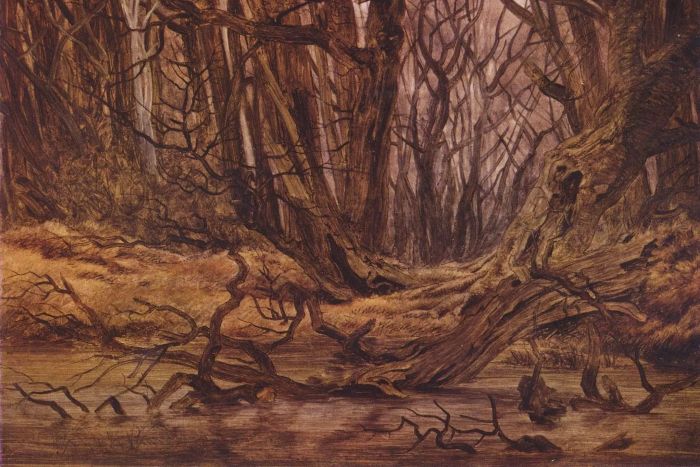
Our woodsy New Hampshire property in the countryside was vast, and I had felt such warmth, such natural love for the land at one time. I had used to rise before dawn and walk the ancient Indian paths that crisscrossed the temperate jungle like a hidden highway and watch the sunrise through the mesh of tree limbs. Immense old-growth oaks and golden maples stood like giant sentries about us, and in spring after a long sleep, they awakened in flower. I gazed up at them with awe and adoration, a kind of prayerful fear, as if they may open their knotty, ivy wrapped trunks like mouths and croak to me in some ancient bellowing tongue. Strolling in this rich and colorful wonderland, as the dew was burned away and the orioles and crows began their war of calls, was like exploring the corridors of some exotic palace. Blue and purple and green and pure white and pink. Waterfalls and mists and the voices of insects. Wildflowers in bursts, lakes of cerulean, crimson. Trails of orange buds or holly walking up the chalky sides of birch trees. The wild lady slippers, with their pearly white bulb hanging, nodding their soft heads beside the protection of a clutch of fern as high as my chest. I rolled mossy boulders into a brook, found a long stick for my staff and hiked onward through the endless forest toward the deepest valleys and groves where I kicked around farms, apple orchards, and ruined old colonial homesteads, the only evidence of which now were empty, crumbling stone foundations, a fetching archaeological site in which I might dig up muddied old glass or tin vials stamped in archaic letters and symbols — milk of magnesia, cure-all, peppermint perfume.
But now was autumn, season of decay. It was cold and late, and the light was flowing out of the day. My father in his unlaced boots stomped yards behind me, a flashlight in his pocket, driving me forward like the master of a team of sled dogs. An afghan from the living room wrapped around his still-naked chest and shoulders, he whistled and called and cried for Gretchen until his voice went hoarse. When I remained silent for too long or appeared to be bored or unhappy, he pitched a stick or a stone at me and shouted for me to keep my stupid eyes peeled.
Soon it was close to dark. We were deeper into the wood and had circled the house a half dozen times. I knew enough not to complain or suggest giving up — he hated quitters. With the added moral element of our poor missing dog, he would have found me doubly guilty of selfishness and inhumanity both.
As the sun retired beneath the furious orange tree line, he switched on the flashlight, and his crunching footfalls came to a halt.
“Walter . . .”
I turned back. He stood still in the weak light, aiming the beam into a cocoon of undergrowth and rot. As I came close a gentle whine arose.
Gretchen lay under a natural bivouac, a nest of brush and damp, dying fern, curled up and whimpering. I had passed this spot not moments before, possibly more than once. She hadn’t begun her fearful moaning until my father appeared. She didn’t want to be found.
He fell to a knee and began manically to pull back the sheaths of dross and brush. She growled weakly, baring what was left of her teeth, then let her chin fall to her soft resting paws in resignation. The cone of light revealed a wound in her side — she’d been attacked by something: lynx, bobcat, a lone gray wolf. Or she’d fallen — it was impossible to tell. Hardly able to move, her slow breath imperceptible, she was bleeding out, and very close to death.
“What do we do?”
My solemn father was silent at last. He reached down to touch her bloodied head. She let him. She did not appear pleased, yet retained a kind of pride in death, her animal dignity. She was impatient to die. As I crouched down, I saw the tears staining Leonard’s reddened cheeks.
I looked to her injury. The bone and flesh of the ribs were exposed; the long ugly wound was cold and firm, the damp meat toughened or congealed, a welter of warm blood seeping sluggishly from its center. We didn’t dare touch it. Her hindquarters were paralyzed. The fatty white rim around the red gash, and the black hair wet with blood, glistened in the strong light beam. A back leg was broken. It looked as if it had been gnawed at. She was trembling. She’d been here for a long while. There was no hope left.
“Poor girl,” said Leonard. “My poor girl, my Gretchen . . .”
The dog had been something of a symbol of his love with Celia, my mother. They had picked her up as a puppy just before I was born, making Gretchen a little older than me. She had been at times my only friend. More like a sibling. Most nights, she slept in my room, nuzzled up warmly beside me on my single bed. As a boy, I had spoken to her like a friend, whispered into her ear. She needed nothing from me but my love, she couldn’t understand my words, and so I confessed into her scruffy ears all my childish secrets.
I felt myself welling up, but I didn’t want to cry like my father. I was down on my knees. He stroked her cold fur. Her big sleepy dark eyes, the lids fluttering slowly, looked at me with recognition. And she licked my hand. Feeling the familiar soft warm sandpaper on my knuckles, I burst out uncontrollably.
I relented, and I cried very much; the tears came on and poured all over the forest floor.
As we knelt there with our oldest friend in the darkling wood, Gretchen died in front of us.
I thought I’d never seen my old man so heartbroken — not when my mother left, not when his own father had died. He’d taken these things in with his now-vanished stoicism.
When I left and returned to the spot with a spade, I stopped short. Leonard had collapsed on her corpse. Wailing. Weeping, caressing her still-warm body. Still half-nude, he began to howl and scream; he told me that I was coldhearted, that I didn’t know how to love, to care for things. Then he went quiet again. The minor glow of evening light was soon gone, and the forest silent and all black. There was a lifting breeze. The bitter cold descending. I waited a long while. I picked up the blanket, which lay in the mud and leaves, and dressed it over his back. He waved me off, as if to impress something upon me, as if what he were feeling I could not withstand. And I don’t think I could have then.
I sat shivering on a narrow stone and waited for my father’s boundless mourning to be complete. I gave her my own wordless goodbye.
Close to midnight, Leonard went in. I buried the dead dog alone in the garden.
2
I was, of a fashion, born in mild deformity. I don’t like discussing it much, but as I’ve handed myself the task of setting the record straight here, of disabusing the public of certain myths about my father and of our misadventures through the headlines, I figure I can take the opportunity to touch on other areas of life. One gets so few chances to speak clearly and freely, to throw the head back and bellow out the truth, that in a way I can hardly resist.
In my first year of life, I had surgery for dramatically clubbed feet, and I never quite learned to walk evenly or with confidence. As I grew and the deep scars healed, I was flatfooted; my left leg sprouted normally at first but never attained the health of the right: it’s three quarters of an inch shorter. This causes me to limp in bare feet. What the newspapers interpreted to be the result of physical abuse from my old man was the expected pain caused by an uncooperative body. As a child, I was issued remedial pairs of sneakers and a heel insert to make up for the disparity, and it could often go unnoticed — but the biting pain could be extraordinary on certain bad weather days. A doctor explained in some detail the grinding axial pressure and nerve strain this lopsidedness puts on my joints and spine, and that if I weren’t careful I had a future of back and other surgeries to look forward to. Nothing seemed to permanently resolve it. As a child, for the random spurts of bone and spinal agony there was nothing; I was expected to endure it. When I reached a certain age, I was given my first pain pills as some relief. Leonard never allowed that I take them.
These struggles of mine caused my mother to weep. She felt that, in some way, she was responsible for this. She was from the French territories up in Canada, and a very emotive type. Very beautiful, wispy, poetic, loving. One of my earliest memories is of her digging in the garden in summer wearing jean shorts, black crows’ feather earrings and pink shoes and sunhat. Often she wandered the property topless or completely nude, sunning in the grass or on the barn veranda attached to the disused hayloft. She had a very beautiful singing voice, sweet, sublime, glowing as if with the embers of a softly burning flower, and she crooned to me gentle as an angel.
Fais dodo
Colas mon p’tit frére
Fais dodo
t’aura du lolo
Les gentils oiseaux
ont des chants nouveaux
Pour l’p’tit frérot
qui fait bien dodo . . .
I can hear it now, the shapely vowels, the rising plangency of her flutelike music, setting my baby mind to easy sleep.
She and my father had met at the University of Connecticut campus in the 1970s. They encountered each other on a bus tour, and he liked to say that on that day in October of 1976 he sat down next to the prize of Celia Guénonand never left her side. Her intelligent eyes were a serene sea blue, mingled through with wormy traces of gold. He was shooting his big round smiles at her and wearing a thick Cossack handlebar mustache, an au courant style he believed appropriate for a future professor. He was funny, lively. He was excited about all of life. Celia was studying agricultural science, and he was fascinated to listen. It was instant passion and devotion from the start. “It was a big, magic love,” my father had used to say. To the day he died, he always believed there was something literally magical about love.
From that day onward every moment was spent together. They were graduated and married, and I was born, and they moved up near these idyllic northern hills of Easton, New Hampshire, where I grew up.
He was hired by the high school right off, and he became their star history teacher. For over a decade he taught senior students. A bearded, beloved, paternal presence at the small school, it was his warm, rational voice that guided hundreds of children along the chronology that began in Antiquity through the decline of Rome, the Dark Ages and Enlightenment, then delivered them through the gates of the First World War unto so-called Modernity, leaving them gazing backward upon a series of events that seemed to have conveyed them, as if inevitably, to his own concluding lecture on the final day of school. He was charismatic. He was learned. He was admired. Everyone had loved Leonard Melungeon.
Then he changed. I can’t say how, precisely. So I write it.
The first incident went like this. During an ordinary senior class seminar one day in late September Leonard stood up, marched around his desk, and walloped a 17-year-old student, Mikey Hoyt, in the face with his fist.
This tall, strapping kid with whiskers already on his chin fell to the filthy linoleum floor, squealed like a baby and began to blubber and cry. “You broke my nose! Mr. Melung’n! You sonofabitch!” Blood spurted from his lip and all over his misaligned teeth. The other students, shocked and frightened, shouted and some began to cry. Leonard, as if waking then from a dream, left the room.
“Let them arrest me!” he later shouted defiantly. “Let them persecute me! I’ll be villain, if that’s what they want — !”
But they didn’t want a villain, they wanted merely explanations. I felt personally exasperated by all this, his new and wild unpredictability, his outbursts. He was a different man, overnight. I admit to being captivated by it, too. Suddenly, he was depicting himself as a kind of wise warrior, a philosopher subjected to the punishments of an evil king. “I am learning to see,” he growled, lifting his free weights and staring into his mirror. I thought that underneath his skin there was spreading a shadow network, a freshwater sea of new ambition. He seemed taller, more robust, more alive. It was true. He was growing. As if he’d kicked away a century of restraints and now roamed free.
I knew also the student in question, Mikey Hoyt — but only enough to avoid him. He was an awful kid. Since the day the Hoyt family had moved to town six months before, their young only son had been a nightmare for the community, the high school, and for us personally. He was crude, truant, bullying, sullen, unpredictable, intimidating even to fully grown adults. At school, one always knew when he was coming: cackling and hooting like an ape, he bashed the locker doors as he stomped his way down the halls, howling and spitting and provoking awful bloody fights. Our mild-mannered and aging hill country administrators were stunned and terrified to paralysis, uncertain what to do with such a person. I was frightened of him myself — I couldn’t see how one wouldn’t be. With his empty stare and wide eyes, stalking about the school like a gorilla, he bore some message of a horrifying outer world to which our small community had little immediate access. He brought junior high school girls to the cemetery and molested them. His breath reeked of beer. He very much looked the part and seemed to enjoy his role as terrorist, with delicate, pinkish streaks of scars along his mandible and cheek, as though he’d tried shaving with a cheese grater; a small misshapen head, the scalp nicked all over in cicatrices, shorn clean but for a short cape of black bangs that lay like a curtain above two eyes dusted in black eyeshadow; and his torn, unwashed secondhand clothes, which stank of kerosene and cigarettes, topped with oversized work boots, absent laces, in which he clodded around the halls. Few could stand his fidgeting and roughhousing, not peers nor parents nor counselors, yet he appeared to have adapted to this lonesome fate. He reveled in his friendlessness. In private, I sometimes envied Mikey Hoyt. I could only think of him grinning.
My father, up to then only very patient and caring with his students, took unexpectedly hateful exception to this one boy. He couldn’t explain this: misbehaving students, after all, weren’t unusual. Even Leonard’s secret feelings about it were, to some degree, expected and shared among the faculty. What was new was his inability to restrain his repugnance, the violence of his disappointment, and to present the sane, even-keeled Mr. Melungeon he’d always been for colleagues and pupils. I admit, there was something especially radioactive about Mikey that suggested even deeper horrors and nightmares. His aura ignited bitter and lethal feelings of a higher order in my father, just as in myself. The manifestation of this particularly morose, implacable, senseless sort of kid was, to Leonard after years of teaching, completely new, and I think he viewed its presence in his classroom and life as a harbinger. A kind of living representation of the endtimes.
He was remorseful about it all, he told me so, but it was a sense of remorse that did not last. When called upon to do so, he refused to apologize or accept blame. The administration, he said, was at fault. The school. This country! The Hoyts should be the ones apologizing. When asked what the boy had done to provoke him, he declined to explain.
This left the school no option: they put Leonard on leave while they contacted the family. But the Hoyts were on vacation in Colorado, and Mikey had been at home alone for several days. They were having trouble getting in touch. Finding a place to put him became a priority, but of course no one would take him. So he languished in a town jail cell for a night, then at a Catholic boys’ home out in Enfield.
One evening, he escaped, vanishing from this temporary shelter into the woods. No one could find him, no one knew when the Hoyts would return, and none knew how to cope with what was an entirely novel state of affairs for the woodsy backwater of New Hampshire: a lunatic child lurking the forest, seeking revenge.
3
There were things, psychological stratagems, my troubled father used to use to maintain control. He wanted nothing more than control — of circumstances, people, time, history. Himself. After Gretchen died, he used her memory to this end. He never mentioned her name to me again, but there appeared between us a great and malignant divide. He viewed her death as my doing. He wanted me to feel the guilt and pain of the consequences. But since I hadn’t done anything wrong, and since I too had loved her, I could not see this thing the way he did. It became harder for us to understand each other’s words or behavior. He began lashing out. We communicated like monkeys or like kidnap victims with their mouths taped shut. He hollered and jumped and bashed his fists. Often I caught him crying alone. But mostly, when not out in the drive fixing up his useless broken-down cars, he could be found madly and constantly exercising in the barn or jogging in the woods. I was frightened of him. Yet I never thought of running away.
My once-eloquent father was no longer able to think straight, to connect the simplest of ideas, his own sentences. He lunged from one notion or impulse to the next, no warning, no explanation. I listened to him rant and rave, utterly disarmed by his urgency and incoherence. “They say, refuse to play along,” he might grumble “ — with the filth, the grift handed down to us by our forefathers — and refuse even to embrace life; Hell, they say you’ll refuse to even be a part of life! Ha!” He’d once had a strong, lovable laugh, but now it seemed so forced and hollow. I turned away when I felt it coming, embarrassed to see his teeth and pale slug-like tongue and his distended, colorless cheeks.
Ultimately, all I could do was bide my time, listen and nod, and do whatever it was he told me to do.
There was, also, the catastrophe of his manuscript. He’d been working on a volume of history — revolutionary, innovative, sui generis, he said — for years, nights mostly, writing it out in pencil. By that year, it had been rejected by all major and minor publishers; he was furious about this and blamed a man with an odd, feverish-sounding name which he kept muttering vengefully in the dark: “. . . Jünck . . . Cheri Jünck . . .” He decided, in despair, to force the mountain of pages on his friends and colleagues who, bored and unable to produce a cogent response, one by one became enemies. Now, without a job to go to, he was indigent and aimless. He grew irritable, inconsolable. And fat. He stopped work on the book, and began working out his body. He spent the majority of his time wandering the house and jogging the property and lost his ability to focus mentally.
For the failure of his book, he blamed television. Television, he said, that soft Satan of the secular age, spiritual cotton candy, a sedative disguised as a puppet show. Children were reared before its rainbowed omnipresence, its pastel colors and oompa music, its manipulative emotional inversions and swerves — from narrative pathos, suddenly to the jarring clarion of a toothpaste jingle, then to the psychological piston-blow of breaking news replete with blood-soaked graphics — this whiplash had created generations of emotional cripples. A fractured nervous system. Wit, love, earnestness, all endangered and in decline. The emotions, he said, were what were dying. Not the capacity for intellection, which was actually vastly increased. The heart — one needed strong sentiments and feelings, a lively consciousness, to read clearly and to understand ideas, art, history, even one’s own thoughts or that of one’s neighbor. A man could consume a thousand headlines a day, cope with a hundred luxuriously detailed plots in an afternoon, if he had strong love in his heart for it. As it was now, people soaked their spirits in all this stimulation and went to bed late with an amygdala sapped of nectar and a soul ringing like a bell, echoing with the monkey hoots and ape shouts that originated in the broadcast production dungeons in New York, Los Angeles, Chicago. We were all innocents standing in the way of the fiber-optic train, deer on the tracks ritually mowed down by the machine engineered by Tom Brokaw, Peter Arnett, Bernard Shaw. These were not great men, he said, but they appeared great in the absence of alternatives, and looked august and fetching in their expensive suits, and thus were elevated within the spiritus mundi — occupiers of the mental landscapes once reserved for the poets and philosophers and theologians — and in spinning their infinite webs of cheap thought, he said, they could be considered the cut-rate Victor Hugos and fire-sale Marcel Prousts of our day. And a simple man, with a simple and important book like his about the deep grammar of history, could present no serious threat to these titans of the occipital sense, these Homers of the audiovisual, these godlets emitting their technicolor rhapsodies into the frontal lobes of every child in America. In this context, his work was of no use. His thoughts remained his own. His words dead.
As he lifted the Louisville slugger and began bashing our TV set, which was the big old wood-paneled model that sat on the floor like a piece of furniture, he turned his ire toward radio. Radio, too, had infected our bloodstream, even to a finer effect than the audiovisual forms. What were these voices arising alienated in pure air but the songs of the evil dead, the irresistible dithyramb of unseen Sirens? The screech and squeal of this audio-squalor had been inherent even from the first Crystal set, its mumbling diabolism detectable in the first record played on the very first 19th-century gramophone. The machines came into the world with a set of metaphysical convictions of their own: they sought to eliminate the heart and entertain the mere senses. A man was no longer a man when he stood immobilized by vagrant voices from the clouds, trapped in place as if by a spell, listening to the reverberations of his own incoherence. What did a housewife in Maine want to know of the labor strikes in Texas? What could a schoolboy in Hattiesburg have to say about the coronation of the queen in Britain? As the breadth of knowledge expanded, the heart shrank, and disappeared, understanding became impossible and the mind was impoverished, a fledgling knowing not in which direction to fly. And it didn’t matter, he said, what the voices in air said or the magic pictures told us, it only mattered that we heard it. It only mattered that it appeared like Pallas Athena or Zeus in one’s presence and intoned its hexes and jinxes and incantatory music. That it was available was how it corroded hearts. Its very existence pointed to death.
But the first technology, he said as he shoved the shattered and dislocated TV tube screen through the window, to ever have the power to represent the world and kill the heart, to invade the soul offering an illuminating and captivating and a most nonsensical picture of all on earth, was the book. In particular, the novel. Novels were, in fact, among the first pieces of entertainment to be broadcast on radio and television; the novel was the first representative form to delude us, the first to pervert the soul. Among its very best practitioners were many who sounded the alarm, Cervantes, Flaubert, Bellow, attempting to alert us to the dangerous confusions and distractions that existed between its pages. To no effect. This illegitimate medium spread across Eurasia like mental fire, and the novel captured the universe of man so completely, devastating the heart and perverting the mind so irretrievably, that the species never recovered. From the very opening lines of L’Astrée scratched out with ink upon a scroll, it was foreordained: mankind began his zombie march toward the inevitability of industrial-scale telecommunication and global broadcast media. Entranced by visions of other souls, spirits haunted by fictive ghosts, voices not your own tracing the neuropathways throughout the body until every cell hummed with the muddled yapping of the universe, it was only a matter of time before the criminal novel changed form: its phrases became stereo voices, its sentences digital pictures, plot structures tangible virtual reality.
So, really, it had been a very foolish thing to spend his life trying to write this book, he said. It was fated that he would fail. The context was impossible, the oceans of psychic sludge too vast and too old, and by this time celebrated as a tradition, to have allowed his genius to persevere. He decided: it was right and proper that a truly free and moral man use only his voice. Only his actions. This was the way forward.
Was it coincidence that the greatest of men remain free of technology, free even from the written record, projecting their voices intangibly through history? Shakespeare whose very existence seems in doubt, a figure like a shadow calling our names from the stage. Socrates who never wrote a word and insisted that the poets restrain themselves lest they imbue men with doubt and fear of death. Jesus Christ who overturned the moral history of mankind only with his Word. And Homer, that specter furthest back in time who with his blank eyes seems to gaze through us toward the future. These men had no truck with technology. And nor, he said, as he doused gasoline on the old television set and lit it afire, would he.
Yet he seemed, nevertheless, trapped in this universe which he described so witheringly, unable to remove himself from the dangers he detailed to me. He awakened me in bed one night to tell me with tears in his eyes that he’d lost the ability to dream. Every night, he said, he greeted a vast soft black inner sea, an endless blankness like an eternal curtain, and a silence more immense than all of time — and it frightened him. I didn’t know how to interpret this, and my speechlessness was yet another sign of my betrayal, another reason for him to distrust me. This nocturnal panic, the loss of color and vividness, above everything else seemed to antagonize him.
“Do you think I’m crazy?” he said.
“I don’t know.”
“Do you think other people think I’m crazy?”
“I don’t think so.”
But I knew by then that they did. The neighbors, local police, his former colleagues, former friends, family members — everyone knew of his struggles and suspected he was having an episode. He was terrified above all that others knew the goings-on of his innermost mind, that they somehow knew his most intimate fears better than he.
I must say now, however, that I quibble with this judgment of my father: the demented reputation that followed him to his grave. Madness has no defenders, but in my love and devotion to my old man I began to doubt the commitment we claim to have to reason — it seems to me in its own way threadbare stuff, this sanity business. A desperate and arrogant choice made in the face of anarchy, a consolation rather than a sober decision. As the universe erupts catastrophically about us, threatening all we hold dear, all one can do is seek the comfort of order. And that’s all sanity and order may be: a calming consolation. Leonard had chosen to flee from under this veil of thought, which he viewed as a trap and a monkeyshine. He chose to deliberately defy the ongoing sanity craze. He wanted to clear a new path to the truth. The current theory, he concluded, had run its course and failed. It had led to television. This meant that history, somehow, had died. And the spirit was at war with itself.
“Fraud, freak, fake, kook,” he was saying, “crook, criminal, huckster, sheister, quack, charlatan, con-man, chiseler, cheat, swindler — why, that’s good American vocabulary for you, my son, get a pencil — !”
Nightly we visited the lumpen grave of Gretchen. We laid food out for her ghost, and lit candles and placed crosses. The site became a dumping ground that attracted raccoons, rats. It got so that I began to loathe her memory.
I think that’s what Leonard wanted. Not to just turn away from the present, but to explode the past. To make of memory a site of repugnance and ruin. Even to erase all history.
Soon, he would achieve this.
4
He began to cackle a lot. Cheerful, seemingly. Expansive. With time on his hands, his wife gone, his job in jeopardy, his money dwindling, his book dead, his reputation in the gutter, he played as if everything were a big entertainment, a big success. Pounding the tabletops. Shouting. As if he’d received some message from beyond, some mission. And it was all coming together, though he’d never explain to me what. Patches of white saliva gathered at the corners of his mouth as he gnawed his meat-and-bean dinners. I was increasingly disgusted by his odor, his presence, his berserk impulses. He worked out constantly, squatting, lifting, and jogging, jump roping ever harder and longer. In the barn were his dumbbells, a medicine ball, a chin-up bar, a steel bench press and a set of big round iron weights. By this time, he was spending every day out there, every free hour, sweating and mouth-breathing like a buffalo, pounding at those once dust-covered instruments, jumping and lunging, exhausting himself, yanking and pulling and heaving, cranking up the vast iron plates and slamming them clacking back down again. I think he felt like a newer, a bigger man. Fifty pushups; a hundred. Lunges. Pull-ups. Lugging rocks around. Twenty-pound weights, 40-pounders. I didn’t connect it to the events of our little life then. I’m not sure there was a connection. What caused what, who could say? It seemed somehow unimportant to discover the reasons. There was a blaze of activity, an arrangement in chaos at the center of which sat my furious father. With some mixture of pride and vengefulness, he leered at me with his watery eyes — he often seemed on the verge of a great sob again — and broke out into those big toothy surprising smiles. I began to feel that maybe I hadn’t known my father at all. Or that maybe I or my mother or the school had really hurt him in some soulful, fundamental, invisible way. I was frightened, I admit, and felt like he might burst through my window at night while I slept, and loom over my bed harrooing wolfishly in the shadows, the lightning webs on his skin glowing hot orange and bright. I could smell his filthy, sweating paws souring everything he touched, the door knobs, the silverware, the light switches, the grease of his fat heart extruding through noxious glands and contaminating the stained walls.
I’m thinking of my sturdy old father now, emerging from the barn sometime around midnight, and stepping into the lambent glow cast by its single light bulb, strutting out in the cool fall weather, his ghostly fog-draughts of heavy breath vanishing as they appeared. From my bedroom window I watched him. Statue-like, as if cast from stone, in his imperfectness he appeared somehow beyond health. As if the web-like remnants of the complex of white scars along his arms and neck, the squat compactness of his upper half, were mere biological burdens failing to draw down the superior engine of his spiritual wealth. I don’t know how he came to be so heavily and densely scarred — but I do recall him being struck by lightning one spring, as he ran shirtless in the rain along the woods paths. The blaze of fire shot him clear from his trajectory and flung him meters into the air. He was left unconscious. Deep in the night, once the rain had ceased, he returned to the house covered in muck and mud, his glowing eyes peering angrily about as if into a world proven treacherous and hateful, and, as my mother washed him up, we saw a branched web of red contusion spreading the length of his chest, arm and back, hair-thin lines revealed, intermingling with the thick pale piping of the old scars. The new red traces, like the intricate veins upon tree leaves, were glowing and warm to the touch. He was incredulous that the earth had tried to destroy him. Betrayed, again, betrayed. So easily could the storm of death overtake you, he felt, and with such deadly disinterest that he began to weep. He gripped my shoulder like a vise, a man risen from the dead, and I felt the power of his sobs ripple through me.
It was after that odd moment, of which he never spoke again, that he began his new life. It was as if the weather, the sky, would get its comeuppance, and he would be the man to fire a deadly bolt backward into the blue.
Each day, my father would drag me out to the shed and we would tinker with one of his cars again. At times this felt like slavery, other times I enjoyed it. Much depended on his mood.
He and I climbed in front of his ratty VW bus to test the starter, and when it sputtered out again with a hiss of black smoke he shouted: “Fucking crankshaft!”
We covered it in a plastic tarp and went inside for the keys to the pickup truck.
“Of course they’ll want vengeance,” he was saying. “You know, it kills people? The capsules. They’re packed with saw dust and cyanide — ” The parents of Mikey Hoyt were rich, in the business of selling vitamin supplements, something we hadn’t learned until the incident. “It’s all salesmanship — provide a narcotizing placebo at affordable prices, so they can uphold some moronic self-conception and sit like a dazed sheep in front of the TV. You know how many of those heart-stoppers fly around the world in a year — probably trillions. And all it costs them is some digestible plastic and a bag of fine-grain sand. They’re manufactured in India anyway, and probably have actual dirt and ape shit in them. For a dollar a bottle you feed them to sick kids and the elderly — presto, you’re a business genius with a million bucks —
“A punch in the jaw is what that kid needed,” he growled. “I bet you it was the first time someone showed interest in him — ”
At dusk in the pickup, we cruised out to their enormous house on Donnybrook Lane, in what was a lakeside high-end neighborhood on the outskirts. He stopped at the base of the hill high with monkey grass, where we gazed up at its facade. The automated exterior lamps flicked on and glowed at us, lighting up our faces. “Look at that — foam and plastic,” he spat. “It’s like a nightmare factory.” He often said the development and global spread of plastics had cheapened the world and life. And he wagged his disapproving head. I often, I admit, found him tiresome. But sometimes I think he convinced himself that he was for the good, that he felt for kids like Mikey, and that he had done the boy and the community a good turn by knocking him to the ground.
In any case, their home looked very agreeable to me. Up beyond the wrought-iron gate a steep, winding drive dressed in scads of tulips led to a white columned portico with a tall crimson front entrance, the porch surrounded in green hedges and manicured holly bushes. Rows of great glassy windows bulged and shined toward the silent hills, and you could just see through the panes to a warped view of the 20-foot cathedral ceilings, gleaming white oak floors, empty dining rooms and multiply chandeliered foyer. It looked like an incredible mountain mansion, perhaps a little loveless and void, but my father seemed to think it would fall over in the first strong nor’easter. “Everyone’s an architect. They build houses from the inside out now, no sense of symmetry. This used to be a pretty hill for butterfly catching and watching the sunset — look at it now. Three people live in that gigantic monstrosity.” He showed me the pitchfork of his greasy fore, middle and ring fingers. “Three. You see what I mean? Nobody cares about architecture anymore, Walter. We’ve got to accept it. . . .”
Accept what, I didn’t know. But as he spoke, two drooling pit bulls manifested, muscly jet-black shadows streaking across a lawn, and they raced each other to a raised wrought-iron garden fence where they bayed and lunged at us.
We took off for the car parts at the Exo, which was of course closed this late in the day, so then downtown to the Market Basket for groceries. But this was closed up, also, by union protests.
“Miserable fuckers,” was all he said. It began to rain. He sped out of the lot, hugging the splashy curb and cursing at the placard-waving strikers.
My father often just drove, with no telling where we might end up. Though he wouldn’t admit it, I knew he feared a visit from Mikey, or the police, or Mr. Hoyt — this was the reason he’d pulled me out of school. To protect me. Who knows what that insane kid would do — could he get hold of a gun? A machete? A bomb? Did he have the psychology of a real killer? It was possible. It was, despite myself, exciting. Just a baseball bat or a chain would have been more than enough for trouble in the hands of a maniac teen who’d been humiliated in front of his peers, and my father had already proven his willingness to hit back.
We linked to the 101, on the way to Stratton, the next town over, which had two grocery stores.
“Who am I to talk?” he said, suddenly. “I teach history to orangutans all day.”
We passed the strip malls and gas stations and fast food restaurants and pulled into the massive parking lot on Portsmouth Avenue, my father now deep inside a full yammer. Collecting the duffles from the truck bed and walking me toward the grocery door, he began to lay out his big theory. Since my mother left, this set of ideas, which often changed in its nuances but remained true in its fundamentals, had become very familiar to me by then, and I’d begun to loathe hearing about it. . . .
People’s minds, he said, were garbage dumps and cemeteries. They wanted out. They wanted — out of the trap. Who could stand it anymore? We all had a Monkey Mikey inside us — and soon we’d be a nation of Monkey Mikey Hoyts. Erratic. Impulsive. Ignorant — but proud. Running over the lava fields on pure survival instinct. Everyone from the poets to the priests to the politicians had given up trying to coax us back to wisdom. There were no more great things, great books, no art, nothing to grab onto. History! which was dead — lifeless. Monkey Mikey . . .
But Leonard wasn’t upset by the supposed death of his field, because he knew what the new world wanted more.
“Each man devours the self,” he was saying, “a universal quest, a spiritual endeavor all its own. One and all shuffling off to elsewhere, and it doesn’t matter where as long as you commit to an original scheme.” He widened his dry lips to bare his teeth as he enunciated the word scheme. It was an important word for him: we needed a scheme, a good one. For, look at it politically, he said, with our slick new sax-playing president, drawing his fingers through his flawless gray hair and in his Arkansas twang announcing a do-over of the social contract. Actualization, he cried — Lenny Melungeon, the Self-Actualized! We were fleeing, writing goodbye letters, screenplays, filling journals with it all — the lament of the abandoned. It was such a stupendous nation, a vast, glowing notion — of rivers of crowds, of teeming cities and of highways and of waterways, throngs dashing, storming for the exits. Nothing holding you back — the world open to every last man. The essence freed up and whole towns disappearing and touching down again, like magic, in Mexico, Malaysia. The earth couldn’t hold us — nor Time. We’d cracked the spacetime code, dissolved into the vibrating particulates of our desires, walking impressions of ideated selves. Vaster and vaster rivers of liberation, greasing every wheel. Being naked as man and more massive than the Pacific he was slouching over the earth like a tide — arriving and departing simultaneously, grazing every lip and pocket. Every last shard of life. Withdrawn from the broken whole. Withdrawn! Everything everywhere breaking up. Breaking apart — renouncing — foregoing — dissolving — seceding — fleeing —
I viewed ornate, obscure tirades such as this as windows into internal torment. The mere fume of a fire within. Certain psychological states are projected into the world, and just as a great fire expels heat and carbon and light, a mind breaking down throws off its ideas, its neuroses. I was just a scared child. But I didn’t feel that way, not at all. I began to feel proud and worried for the future, even willing to be recruited into his insane crusade, some heroic, asinine adventure. This was a new way of things now, he said, and it was calling out names.
Our names. We had to get in on the action. We had to make of it a way of life.
After we passed through the bumpered auto-doors and into the grocery, my father’s voice rose until it boomed over the muzak, and I saw once again the stares. People stared at my father in a particular way, with unusually forthright disgust and hatred. Who could blame them? He was usually dragging me, or formerly my mother, alongside him as he shouted and shrieked. Our private family drama had leaked into the public view. His new ill-repute had spread, and for a short time now the old reliable schoolteacher Mr. Melungeon had been dead and forgotten. What was this lunatic who’d replaced him?
We lingered over the meat freezers. He’d been pursuing a diet of total meat and protein consumption, beef and animal organs, and so we roved in the pale lighting again picking over piles of chicken carcasses, shelves of plastic-wrapped chuck roast, salmon filet, fowl hearts, pig feet. The cold meat smelled like metal and clay to me. My stomach rebelled — the sight of raw, veiny flesh chilling in the open made me ill. Since Celia had left, I’d hardly seen a fruit or vegetable around the house and had had to scramble for apples at the school cafeteria. Yet, it had to be said, as a result of this new regime of diet and intense exercise, my father had lost a considerable amount of weight, and grown strong, and it was this new sense of himself as brimming with vitality, fueled by sheer animal fat that, at least in part, fired him up enough to feel capable of accosting young Monkey Mikey. Eating animals kills fear, he said. Eating flesh delivers raw bravery to the system. He had something to prove now — he was open to me about that. He wanted to knock back the shitheels, rub their noses in their abominable failures — and for that he needed fuel, flesh. He wanted to get it over on everyone, even my mother, with her herb and vegetable gardening, her tender feelings about the earth and sea and animal life. “Fuck the innocent animals!” he was saying. “A native kills and devours a piglet from a spit because he can. He has no need, he simply wants it — and so he does it!” His flaming eyes were euphoric. The human being is a philosophizing brute, he extemporized, using his sensitivities and his intellect and his morals to hold down the world so he can eat it alive. Criminals, the entire species. “The first thing prehistoric man did upon slouching into these Americas,” he said holding up a ham hock and wagging its floppy end at me, “was eat! Exterminate the megafauna — the great mammoths and enormous sabertooth tigers and the great tortoise, humungous land mammals greater than anything you could imagine, gobbled up to suit the desires of small tribes of Mesoamerican cannibals. Compared to a mastodon or a long-horned musk ox, our pathetic beavers and lynxes and coyotes are sissified rats, the leftovers of natural history. The woolly mammoth was the size of a school bus. Ha-ha! And do you know mammals in Asia won’t fuck anymore? They’re scrambling to get them to do anything but eat bamboo and sleep. Even the animals have no lust left for life. Walter, their spiritual immune system is in complete shutdown — because even they know the jig is up, son. Even the animals know.”
“Sir,” said a woman from behind her shopping cart, “don’t you think you should watch yourself, hollering to your boy like that?”
“Why should I?”
“Well he’s no older than eleven-twelve.”
He looked at me, as if in shock, then back at her. “And?” he said, waving his hand over my head. “Pope Benedict! Louis XIV negotiated the Peace of Westphalia at his age. But I bet you know history pretty well? Alexander the Great, taking lessons from Aristotle and committing murder before puberty — ”
Her stunned long-lashed eyes blinked vacantly below a round flowered hat. “Is that what you want for your boy, to be like that?”
“Why not?” he said, “You are!”
“I’m what?”
“A murderer, madam,” he said. He stepped toward her. “A killer on the loose, bad as Ivan the Terrible — like me!” He thumped his chest with a pot roast.
The lady fled, her rusted cart squelching down the aisle.
We dashed to the opposite end of the grocery with our heavy, overwhelmed meat cart, packed the products into the two duffle bags, then lugged the twin burdens through the rear shipping exit.
Half outside beneath the sky by the loading dock, my casual, smiling father — he could toggle his moods as easily as a switchboard operator — waved to the busy employees as if he knew them, and soon we were back in the wet parking lot and at the truck.
“Everyone’s a menace, son,” he said, drawing the truck door shut. He was still smiling and waving his fingers at the grocery workers. “That polite bitch included. How many skeletons does she have hidden under that innocent hat — how do her children feel about her? It’s the moralists who work hardest to pulverize you. Fuck ’em.”
And there it was — his new ideology: Fuck-’em-Allism. The education system, the trade system, the social system, the tax system, the police, the news, and the beautiful universities and the beautiful monuments and the magnificent ideals and principles — fuck them all. I couldn’t possibly know what had fired him up so well about everyone alive, for no one could escape the sprawl of his impotent wrath. Ours was a beautiful new age of abandonment and squalor, he said, requiring a beautiful, squalid new philosophy. We would walk on our hands. We would dance across the swamp. We would flee. We would fly. He never stopped insisting, insisting, insisting upon these wild things.
In less than the past six months my father Leonard had lost his wife, his reputation, his very center, and would soon lose his job and his home and perhaps his freedom — but he hadn’t lost his nerve. He was happy, I mean really brimming with eagerness for some wildly new unknown future. The thing was admirable, in its way, the sheer transformative force of his manic optimism. Yet always, he maintained, the monsters lurked at the edges of life — the wolves, the mastodons, the wardens, the moralists — waiting to suck you into their vortex and descend on you like you were a stuck pig.
“Before you die,” he said, “you’ll be consumed in a thousand different ways, Walter. Your soul. Your testicles. Your organs. It all goes over the fire for the cannibals to eat.”
He turned the ignition, and the truck exploded forward as two portly store managers in green suspenders and plastic ponchos came rushing out, panicked, arms raised.
We squealed out of the lot with our loot, hooked onto the 101 and made the high-speed drive back home in complete silence.

Tyson Duffy is a writer living in Atlanta. His work has appeared in the Times Literary Supplement, Hobart, The Metropolitan Review, Carolina Quarterly Review, Cleaver, RealClearBooks, The Millions, Contrary, and others. He is a Fulbright Fellow and a Fellow at the CUNY Writers’ Institute. His novel, The Idealist, is complete at 472 pages and looking for a home.