

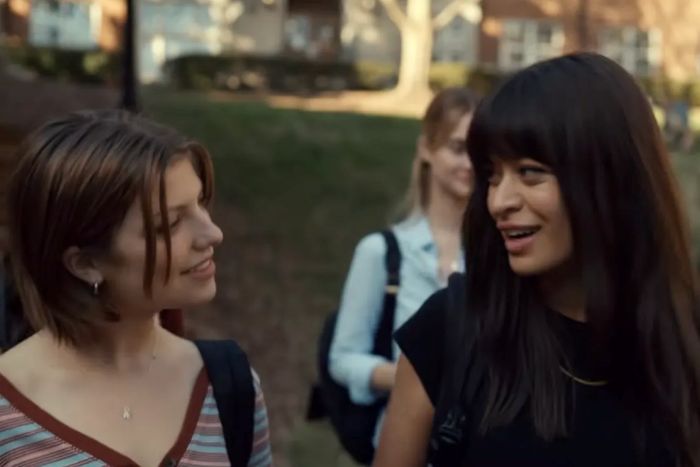
The title of Hulu’s dark melodrama, Tell Me Lies, is an imperative. To read it is to put yourself in the willfully self-deluded position its ensemble of preternaturally beautiful late-aughts undergraduates occupy; like Lucy, Bree, and Pippa, like their male counterparts, Stephen, Evan, and Wrigley, we invite, nay, we demand, our share of falsehoods, comforting, harmful, scandalous as they may be. Viewers begin the show from the self-deluded vantage it explores. And showrunner Meaghan Oppenheimer obliges, spinning us a delicious, delirious, despicable web of specious stories, not only about the interpersonal drama that unfolds inside an incestuous friend group that just can’t stop hooking up, but also about the show’s moment and milieu — college under the waning light of liberal capitalist democracy.
Tell Me Lies is set at fictional Baird, an elite liberal arts institution in upstate New York, and its doubled timeline (2008–2010 and 2015) spans the Obama years. The show invites us to reexamine the shibboleths of the recent millennial past, among them higher education, meritocracy, third-wave feminism, and low-rise jeans, from the wreckage of a present defined by political and economic collapse. As we unearth our nostalgias and our traumas alike, Oppenheimer presses us to rule anew on this eclipsed world’s lies and promises.
Critical assessments of Tell Me Lies often begin and end with its most obvious preoccupation, toxic narcissism. Online culture has seen a vogue for narcissistic personality disorder and its specialized language over the last few years (ask any teenager about the flying monkey, the golden child, the scapegoat) and Tell Me Lies is first and foremost a show about the relationship between Stephen DeMarco (Jackson White), a textbook narcissist and sociopath, and Lucy Albright (Grace Van Patten), his lover and victim. A big part of the show’s appeal is how it marshals these characters for one of the most accurate depictions of narcissistic abuse on record, taking the time to make legible the fine textures, the abject details of Stephen’s power games, the nuances of tone, look, and word by which he secures dominance and doles out retribution. Anyone who has lived with this brand of monster will recognize Stephen’s enormous ego, his deep, dark wound, his bottomless hunger for love and attention, the perverse lengths to which he will go in his doomed attempts to satisfy himself through control and manipulation. The show opens onto this internal terrain through the close-up: most scenes, we’re nearer than Van Patten to White’s intense eyes, his supple mouth, set cruel.
Not that Stephen is a one-dimensional villain. Oppenheimer’s vision of the sociopath is compelling because she roots it in legitimate pain. Amongst his wealthy peers at Baird, Stephen comes from limited means. Worse, his mother is herself a narcissist, finagling out of every interaction the upper hand, threatening her ex-husband’s new partner, pitting her children against one another, against themselves. Because we’re privy to Stephen’s origin story, we’re at first invited to believe, as Lucy does, that he might be different. He understands how toxic his mother’s behavior is, and he’s smart, so smart, or at least he thinks he is.
By season three, however, we know what Lucy learns too late — Stephen cannot change. Stephen spends the first season holding Lucy hostage to approximately one half of his darkest secret: he tells her that he was in the car when her roommate, Macy, crashed into a tree, but we eventually learn that Stephen was in fact driving. Then, after Stephen bombs an interview for a prestigious internship, he abandons Lucy and returns to his ex, Diana, a smarter, more ambitious upperclassman willing to use her family connections to help Stephen professionally. Eventually, Diana will realize Stephen’s nature and free herself from him, and Stephen will take Lucy back, his hold over her intensified, his demands more perverse than ever. In the meantime, however, Lucy begins to unravel. She drinks and smokes. She sleeps with Evan, her best friend Bree’s boyfriend. Later, at a party, Lucy claims in public, for convoluted reasons, that another student, Chris, sexually assaulted her (in fact, Chris drugged and assaulted her other best friend, Pippa), and then, at Stephen’s behest, she admits on video that she lied. Stephen threatens to release the recording, and the fear and terror push Lucy to the very edge of sanity. She doesn’t always know where she is. She can’t remember what she said the previous day.
This labyrinthine plot resolves when Lucy’s confession somehow goes viral, and she is expelled from Baird. At first, we think Stephen shared it, but we learn in the end that Bree did, after discovering Lucy and Evan’s betrayal. Although the show keeps Lucy and Stephen close to the center, it lives and dies by the power of its ensemble casting. Bree, who takes on an outsized role in season three, turns out to be Stephen’s foil, living, breathing evidence that penury and childhood trauma don’t give you a free pass to be the worst, actually. Like Stephen, Bree comes from a background of poverty and abuse. Like Stephen, she cheats, lies, and makes mistakes. She craves, as Stephen does, the desiring gaze of the other; she can even admit this to herself. And, once betrayed, she, like Stephen, takes revenge, lashes out, blows up Lucy’s life. Unlike Stephen, however, Bree regrets this, right away, for years. Stephen never regrets anything. He doesn’t know how. Although everyone else also deceives and double-crosses, Stephen alone does so with impunity, without remorse.
The tenor of Stephen’s abuse we experience through both the show’s plotlines and, perhaps more profoundly, through its formal recursions. Oppenheimer’s synthy iterations and looping narrative arcs draw us into the same repetition compulsion that drives Lucy back into Stephen’s bed again and again. Each time, we know that things are only going to get worse, even as we hope they’re going to get better. The series pressures us to partake in Lucy’s cruel optimism, imagining things can change, extending our capacity to endure harm. We believe, up until the show’s wild end, that Stephen — liar, cheater, drunk driver, killer — might actually get what he deserves.
Tell Me Lies isn’t only interested in narcissism as a personality disorder. Oppenheimer leverages this plot to offer us an anatomy of millennial U.S. solipsism, taking us back to the conditions of its emergence, chronicling the rise of its structures. The series is set in the years immediately following Apple’s release of the iPhone (2007) and Facebook’s public opening (2006), a liminal period when flip phones were still ubiquitous and you had to sit down at a computer to upload drunk photos of your friends to social media (how business casual). No wonder narcissism has since been trending. Its propensities have come to thrive in an online culture that makes bragging about one’s accomplishments and exploits de rigueur. And while Oppenheimer is clear that Stephen’s brand of self-obsession transcends the zeitgeist, his actions fly under the radar in part because they align with this moment’s worst features.
The precise technological logistics proper to the plot prove Marshall McLuhan’s old saw once more: the medium is the message. Bree realizes Lucy and Evan slept together by scrutinizing Facebook, and the platform enables her to rapidly disseminate Lucy’s admission. Stephen, had he the opportunity to record from a smarter device (he does own — and break — an iPhone at one point, a gift from Diana’s dad), might have posted the video of Lucy right away, tempted by the ease of an app at his fingertips. Instead, he films Lucy with a digital camera and saves her confession to a memory card, which he returns to Lucy, and which Bree later finds. Lucy even refers to her confession as a “tape,” an historically accurate nod to Paris Hilton’s infamous and nonconsensual entry into the world of amateur pornography (2004). The fantasy that you can control the images you produce is still in play at this time, although Lucy’s experience demonstrates it is not long for this world. Just as the only solution to dealing with Stephen, a narcissist, turns out to be cutting ties with him, the only option our devices leave us turns out to be an impossible one: never take the nude, never confess on record.
Oppenheimer at once chronicles the species of trauma particular to this period and invites us to indulge our nostalgia for it. Back then, youths could still be trusted to hook up, binge drink, and roll at house parties, instead of staying at home in the residence halls, doomscrolling all weekend. This exciting bad behavior went down in that mythical place, the pre-COVID, pre-AI college campus, once a quintessential staging ground for the emergence of the subject under liberal capitalist democracy. (Tell Me Lies first aired in 2022, the same year OpenAI made ChatGPT available to the public for free. That year, many had returned to classrooms but were still masking.) In the imagined sphere of freedom our economic and political forms historically claimed to produce, higher ed students could indulge in the fiction of personhood, of individualism, with all of its attendant challenges and triumphs, its highs and lows. Away at college, young adults could learn to read, write, and think, to become friends and lovers, to balance responsibility and pleasure, to make independent decisions.
The soundtrack calls millennial viewers back to this dream place between innocence and experience, bouncing us exultantly along the spectrum from millennial cringe to indie sleaze. These were the songs we burnt onto CDs and loaded on our first-gen iPods: Arcade Fire, the Strokes, Gnarls Barkley, Feist, Death Cab, Phoenix, Amy Winehouse. They capture the embarrassing feelings and unapologetic sentiments tied up with our generation’s fiction of freedom and self-development, but the soundtrack also reminds us of what Gen Z wants us to forget — come on, millennials could be ironic and funny, too. Oppenheimer cues up The Postal Service at incongruous moments, layering “Such Great Heights” over our final shot of Lucy, who Stephen has abandoned at a gas station one last time. Right before the finale’s iconic collective implosion at Bree and Evan’s wedding, set flawlessly to the tune of Britney’s “Toxic,” we hear the strains of that millennial anthem, Modest Mouse’s “Float On,” promising us that, whatever is about to happen, this generation is going to be alright.
Tell me lies! By now, of course, we know that isn’t true. As democracy itself faces threats in the U.S. and abroad, the world of the series feels more and more distant by the day. American higher education, for one, is under attack by the federal government and Silicon Valley alike. Under U.S. fascism’s contemporary regime, federal funding has been rolled back. Accreditation practices have been weaponized. Professors can no longer teach Plato in Texas — too woke. Consensus no longer holds that a university education should be accessible for most. In the classroom, faculty have long assumed that students aren’t doing the reading, and now, given AI’s ubiquity, we know that they aren’t doing much of the writing, either.
Given these transformations, Oppenheimer tortures us with a slick, hot version of everything we’re missing. Baird’s pedagogical spaces are charged with erotic energy. In the classroom, students test ideas and share original writing, sparring over differences of opinion on hard and soft power in political science and giving each other thoughtful, if brutally honest, feedback in creative writing. Critical thinking, too, used to be part of growing up, a way to test out your ideals, your position, your beliefs. While the libertine values and charged classroom exchanges on display in the show perhaps better align with the sex-positive ethos of the 1990s, the show celebrates the rigorous, competitive spirit proper to an older vision of the university. Still, Oppenheimer’s portrait is complex. Lest we romanticize too aggressively, the show reminds us to be wary of this period’s worst denizens; Bree is devastated by a predatory affair with a professor sophomore year, an occupational hazard in a more openly libidinal institution. Should we really be nostalgic for this moment, the series asks? Yes, absolutely, it answers, but also, no fucking way.
Similarly, Tell Me Lies at once commemorates and calls into question the twin myths endemic to U.S. higher ed: meritocracy and upward mobility. Until recently, college was supposed to guarantee any student smart and gritty enough to get in eventual access to greater material prosperity than their parents. The U.S. university system came to play, over the course of the Cold War, a significant role in America’s triumphalist stories about liberal capitalist democracy. After the 2008 crash, the first Trump presidency, and the pandemic, millennials knew this narrative was dated. And yet, back in the aughts, we could still believe. Bree and Stephen, both of whom come from poverty, are true believers, certainly, and both understand that their access to upward mobility will not be a purely academic feat. Joining another class requires networking, self-transformation, intimacy. It means leveraging the personal capital of physical beauty and charisma to form the friendships, marriages, identities that will usher you into a higher tax bracket. In college, you don’t only earn a degree. You find a network that can carry you where you want to go. That’s why Stephen chases Diana and cultivates a friendship with Evan, the wealthiest in the group. It’s got to be part of the reason why Bree agrees to marry Evan, too, even though she’s in love with Wrigley.
The final fiction — lie, if you will? — Oppenheimer tells about university life in the early 2000s is that it’s politically neutral. Oppenheimer lets us luxuriate in the apolitical flavor of the Obama years, lets us rest at the end of the end of history, lets us enjoy the drama of the upwardly mobile rent-free while the federal government minds its business somewhere off screen. There are no campus protests at Baird (of course, we know the full span of the show is contemporaneous with Occupy and climate marches). Iraq is over, the Dems are triumphant, the orange one hasn’t yet unleashed unsanctioned camps, unfree elections, and wars, wars, wars. Looking back from our current vantage, we know now that we can’t just float on, happily, indefinitely. In the throes of fascist crisis and escalating violence, global and domestic, the show’s political nostalgia might be its most indulgent and potent strain.
Does Stephen win in the end? Yes and no. Securing Lucy’s favor one last time, Stephen whisks her away from the wreckage of their friend group and drives her off into the sunrise. When he stops for gas, however, and Lucy goes inside to get coffee, Stephen leaves her there in the lot. As the sunlight builds and sparkles around her, breaking across her freckles, her wilted bridesmaid’s dress, all Lucy can do is laugh. In one sense, Stephen has won, again, for good. Lucy chose him, and he spurned her one final time. In another sense, though, Lucy has. She’s finally free of Stephen. She comes to understand what Diana figured out early on — to leave a narcissist, you have to make him think it’s his idea.
Of course, it’s difficult to feel fully satisfied with this ending. Stephen isn’t punished. This is melodrama, not prestige TV. Stephen isn’t Walter White or Tony Soprano. We don’t want to see him triumph. Melodrama pushes us to focus, not on the ruthless man himself, hero or antihero, but rather, on the collateral damage he causes, on the women he tries with varying levels of success to destroy. And the girls, Oppenheimer is clear, are not all right.
Ultimately, Tell Me Lies teaches Lucy the lesson privileged white girls must learn when they cause inadvertent harm — good intentions don’t matter. Lucy is always begging friends, parents, lovers, administrators to understand: whatever she’s done wrong, she’s truly sorry, she didn’t mean it. Although we’re invited to view Lucy as a victim of abuse, and to evaluate her actions through that lens, we’re also prompted to consider if, under that banner, she can still be held responsible for the harm she causes others. What happens if you never take accountability for your own actions? (Children of parents in long-term codependent relationships live the answer to a more pointed version of this question daily: Is a mother who enables a father’s narcissistic abuse at fault?) In Lucy’s case, Oppenheimer’s answer is not definitive. It’s hard to know for sure in a world in which “being a woman,” as Diana puts it, “is a prison.”
The ruling on Stephen’s culpability, on the other hand — and Chris’, for that matter — is uncomplicated. Men aren’t going to be found liable. Sorry. “I just fucking hate that there are no consequences for him, ever,” Lucy says in the finale. “That’s how it is for some people,” Diana agrees. Unfortunately, we can’t be nostalgic for the boys-will-be-boys of it all. That’s a lie we’re still asking to be told.

Racheal Fest is a writer and critic based in Central New York. Her work has appeared in Colorado Review, Pittsburgh Review of Books, Euphemism, NOVUS, Litmosphere, and elsewhere. At Community Arts Network of Oneonta, she hosts Writers Salon, a public reading series featuring writers local to the Catskills and beyond.