

Nostalgia for the indie rock of the 2000s has not abated. There are more indie sleaze retro dance parties in New York City than there are Duane Reade pharmacies. There does not seem to be as much fondness for the alternative comedy boom of that decade. Comedy doesn’t hold up to hagiography as well. It’s less romantic, doesn’t age as gracefully.
It’s a shame that it doesn’t. Much of the indie music of the time was exciting but derivative. Franz Ferdinand impressively mimicked ’80s postpunk while the Shins soaked up all the sunshine pop of the ’60s. Peak TV was incredible, but many of the iconic shows of that era expanded on the aesthetics of film auteurs. The Sopranos imported Scorsese into the living room; Breaking Bad brought the macabre humor of the Coen Brothers to primetime. Even The Wire bears more than a passing resemblance to John Sayles’ 1991 film City of Hope. Of all the artistic movements in the aughts, alternative comedy created the most radical rupture with what came before.
Wait, what was alternative comedy?
Any genre with the label “alternative” would be more easily defined by what it wasn’t than what it was. Though it was open to improv and sketch, alternative comedy was primarily a subgenre of stand-up. It might have moved beyond setup-punch, but punchlines weren’t entirely verboten. An alt-comedy exemplar like Demetri Martin played guitar onstage, showcased his own drawings on his easel and made PowerPoint presentations, but most of his written material consisted of wry one-liners, like he was a twee Steven Wright or a Mitch Hedberg with a bowl cut. What was rare was the aggressive, macho energy of the stand-up comedy boom from 20 years prior. Unlike the indie rock of the ’00s, which revived the ’80s aesthetic, alternative comedy in the ’00s, while not jettisoning setup-punch or observational jokes, had no tolerance for mundane observations of suburban life or for the leather-jacketed, bad-boy swagger that defined comedy in the ’80s. Its rejection of the latter made it analogous to grunge rock’s shift away from hair metal. Also like grunge, alternative comedy, while useful to the left during the culture wars, was not overtly political.
And yet it would end up everywhere on the internet.
In 1990, David Cross had hosted the open mic night at the Catch a Rising Star in Cambridge, Massachusetts. As he and other comics like Marc Maron, Louis CK, and Janeane Garofalo began working there, Cross earned enough goodwill to run a live comedy show his way. Cross and other writers (including future Mr. Show scribe John Ennis) would book fake comics that were intentionally bad and eventually worked in videotaped segments. “Cross Comedy” was a prototypical version of Mr. Show that got popular enough to get the primetime slot at Catch.1
Garofalo moved to LA and kept striking out at clubs like the Comedy Store and the Laugh Factory. Many of her new LA peers were also unlucky, including Margaret Cho, Kathy Griffin, Dana Gould, and Bob Odenkirk. Besides the aforementioned emphasis on high-octane testosterone, there was pressure from the clubs to get a laugh every seven seconds, putting a ceiling on any exploration or improvisation. By 1991, Garofalo wanted a show where comics could bomb without fear, so she, along with Gould and Colin Quinn, ran a comedy night at the Big & Tall Books — a show many credit with launching the alternative comedy scene in Los Angeles.2 In 1992, Garofalo and Odenkirk joined The Ben Stiller Show. Garofalo later brought her old Boston friend David Cross on as a writer.
They would still perform at shows in the growing scene, including “UnCabaret,” run by Beth Lapides at Luna Park. Lapides expressly wanted a space where women and gays would feel comfortable. She also had her own aesthetic criteria, summed up as “do not do your act.” Many comedians told stories off-the-cuff (often retelling events that had happened earlier that day). Sometimes they shared a stoned shower thought, or tested a joke they’d only thought of en route.
Like today, the ’90s were mired in the culture wars, but the overriding ethos of alternative nation — from alternative comedy to alternative rock to indie film — was an absolute rejection of the corporate slickness of the preceding decade. Nirvana spearheaded the alternative rock backlash against overproduced hair metal in 1991. Quentin Tarantino’s Pulp Fiction, in 1994, ushered in the golden age of indie film, winning the Palme d’Or and becoming a surprise blockbuster. Alternative comedy’s revolution was more behind the scenes that decade. Not many comedy specials or albums documented what was happening.
The few specials that did can all be found on HBO’s streaming service Max, including Janeane Garofalo’s “HBO Comedy Half Hour” (1995), Marc Maron’s “HBO Comedy Half Hour” (1995), and David Cross’ “The Pride is Back” (1999). Garofalo and Maron brought notes onstage, which was one of the biggest taboos for live comedy in general, let alone for your big shot. Even the improvisational Lenny Bruce didn’t read off a notepad. This was in keeping with the philosophy of LA alt-comedy: freshness over reliability, prioritizing the moment above posterity. Maron notoriously told jokes in his half hour that he’d thought of earlier that day. While Maron and Garofalo shied away from slickness, Cross was outwardly hostile to it, mocking the insipid commercials and entertainment properties of the day. He also deployed some underutilized tactics during his 1999 special. One of them was found humor; he brought an in-flight magazine and a dating handbook onstage in order to mock them.
Another one: openly mocking celebrities he’d come across — in this case, Actor’s Studio teacher James Lipton (who had a TV show on Bravo) at the CableACE Awards. Since alternative comedians in Los Angeles were encouraged to talk about their daily lives, it was impossible for them to not kvetch about failed auditions, comedians they had dated and, most of all, celebrities who’d been rude to them. This was not common practice before the ’90s — the fear of burning bridges was too great. Steve Martin, Albert Brooks, and even Andy Kaufman followed showbiz conventions. None of them gossiped about celebrities they’d met, lest they appear like Hollywood douchebags. But when the comedy club business model collapsed, many of the audience members at the alt-comedy shows were other comedians, writers and showbiz types, especially at “UnCabaret.”
The impact of ’90s alt-comedy didn’t reverberate immediately. Garofalo was in many films and TV shows, most notably The Larry Sanders Show, Reality Bites, and The Ben Stiller Show; Reality Bites was a hit, but The Larry Sanders Show and The Ben Stiller Show, in addition to other shows written by and starring alt-comedy darlings (Mr. Show, The State, The Dana Carvey Show, and Strangers with Candy) were bound to be cult classics that would be regarded better over time. The largest platform for new comedy back then was Late Night with Conan O’Brien. Comedians like Todd Barry made their debut there, Louis CK wrote for the show, and the Upright Citizens Brigade (a team whose core members were Amy Poehler, Matt Besser, Ian Roberts, and Matthew Walsh) often starred in sketches with Conan. More than anything else, Late Night would lay the groundwork for the ’00s alt-comedy explosion.
Before they established their first improv theater in ’99, the Upright Citizens Brigade (UCB) were doing shows all over the New York City alternative comedy scene. If Los Angeles developed a form of punk in the early ’80s that was more hardcore than CBGB’s stuff, New York alternative comedy was even less mainstream and more avant garde, to a fault. Luna Lounge in the LES hosted a comedy show called “Eating It.” Big & Tall allowed failure; “Eating It” encouraged it. Like Los Angeles, the alternative comedy shows in New York were held outside of comedy clubs at bars, music venues, coffee houses, wherever. All of the comedians from Los Angeles performed in New York as well.
Then there was Surf Reality on the Lower East Side. If there was little documentation of the LA alt-comedy of the ’90s, even less remains of the Surf Reality microscene. Todd Barry and the UCB team performed there, but there were also slam poets like Maggie Estep and novelists like Jonathan Ames. Robert Prichard, Surf Reality’s founder, also nurtured artists that only fit in at Surf and were too weird to cross over — mysterious figures like Mistress Elsa (played by Surf Reality co-founder Jen Pritchard) or Gilda Konrad with her hand puppet Mr. Towel (a green towel). All that remains of these sets can be gleaned from scattered articles across the web. A piece that appeared in the New York Times, “Take the New Comedy Please,” put it this way: “the acts there can range from ex-prostitutes talking about their jobs while taking off their clothes to singers who perform at children’s parties trying their material out on an adult crowd.” Frustratingly vague, since these performers are unnamed and you can’t go to Surf Reality to see them. The venue closed in 2003.
When Marc Maron was getting up at the Comedy Cellar in the West Village shortly after 9/11, he had the gradual realization that some of the comics he worked with there might be more racist than he realized, with their Islamophobic material.3 Alternative comedy in the previous decade wasn’t overtly left-leaning, but it didn’t need to be. Female comics and gay comics simply talked about their lives and the sharing of their outsider perspectives was rebellious enough. Now there was more hostility against Muslims since the U.S. was at war with radical Muslim terrorists. The angry comedy of the ’80s was back. What’s more, very few of the comedians in New York’s mostly white alt-comedy scene of the ’00s were Muslim, so they couldn’t pass off the personal as the political anymore. Maron, Garofalo, and Cross became more outspoken, with Cross attacking President George W. Bush on his 2002 album Shut Up You Fucking Baby, at a time when nobody criticized the wartime president (this was months before the U.S. entered the more unpopular Iraq War). But David Cross also wrote a column for the right-leaning hipster magazine Vice (“My America”), as did Sarah Silverman. Silverman was also gaining notoriety for her ironically racist characters. Many say 9/11 united Americans. In New York, there was a reluctance to criticize the Republican White House, for fear of appearing unpatriotic. Even during Iraq, critics rarely called out the military-industrial complex. Most alt-comedians in the scene, then, especially those who weren’t as established, steered clear of political commentary, preferring to gently roast self-righteous liberals who donated to NPR and wore sanctimonious tote bags. Muslim alt-comic Aziz Ansari avoided talking about his ethnic background until he was world-famous.
This didn’t mean they shied away from social commentary or discomfort in general: a fake website called Black People Love Us achieved virality in 2002. It had testimonials and pictures of this clueless white couple that insisted they were a hit with Black people. It was a sharp send-up of knee-jerk liberal do-gooderism. The website was created by future BuzzFeed founder Jonah Peretti and his comedian sister Chelsea. The clueless white boyfriend whom Black people supposedly loved: Bobby Tisdale, host and producer (along with Eugene Mirman) of “Invite Them Up,” a show at the East Village bar Rififi, which would become massively popular in the second wave of NYC alt. Many of the comedians at “Invite Them Up” were improv performers like John Gemberling, TV writers like Jon Glaser, and newer comics doing wacky characters, the most popular ones being Gil Faizon and George St. Geegland, two rich Upper West Side residents, played by Nick Kroll and John Mulaney (in 2016, they would have their own Broadway play, The Oh, Hello Show, named after their show “Oh, Hello” at Rififi).4
The focus had shifted: in the ’90s NY alt world, most comedy was autobiographical, and surreal performance was primarily limited to the improv comedy of UCB or the native oddballs at Surf Reality. Now, along with more traditional acts like Todd Barry and Mike Birbiglia, there was a larger concentration of absurdist solo sketches and other nontraditional acts of a sort you wouldn’t have seen during the ’90s. As Aziz Ansari told the New York Times, “I [could] bring a girl on stage that I got rejected by and interview her, or do a PowerPoint presentation or show a short film.” Through advances in technology, video segments didn’t need to be fought for with the club owner, as they had for David Cross a decade and a half before. A mixed-media approach was now being encouraged by producers.
If ’90s LA alt favored intimacy, the earlier part of the ’00s alt scene in New York was fueled by possibility. These comedians were pushing the boundaries of what they could get away with, not necessarily meaning what taboos they could break (unless Silverman was in town), but how weird they could afford to get before they got annoying. In earlier decades, oddballs like Emo Phillips and Bobcat Goldthwait were used to break up an otherwise monotonous comedy showcase. Even Conan sandwiched strange characters like Masturbating Bear between monologue jokes and celebrity interviews. Like the restaurants in the area that were starting to specialize in ramen or chocolate, nonsense was largely the norm at Rififi. Agit-prop wasn’t, but to equate the absolute insanity of ’00s alt-comedy with Iraq War quietism is like saying the Dadaists were indifferent to World War I because of their nonsense poems. The material might not have been topical, but it captured the zeitgeist, just like most psychedelic bands in the ’60s, in singing more about flowers than bombs, reflected the spirit of the times.
As zany as things got onstage, there was also a growing respect for writing in alt-comedy. Todd Barry, Jim Gaffigan, and John Mulaney in New York, along with Patton Oswalt and Paul F. Tompkins in Los Angeles, got away with their relatively mainstream approach because their jokes were impeccably crafted.
Comedy geeks, who did not exist as a group before the 2000s, were writing breathless reviews on message boards like A Special Thing. Without the internet, alternative comedy would have been a brief regional performance trend, like slam poetry was in 1990s New York. Sketch comedy videos from groups like Stella (comprised of Michael Ian Black, Michael Showalter, and David Wain, all former cast members of the ’90s MTV sketch comedy show The State), Human Giant (Aziz Ansari along with improv actors Paul Scheer and Rob Huebel), and Derrick (a comedy trio that included a young Donald Glover) had videos featured on College Humor (itself a predecessor for online comedy video platforms like Funny or Die and Super Deluxe). A Special Thing was an essential forum; there weren’t comedy nerd conventions or newsletters. Comedy blogs like The Apiary and Dead Frog (both of which I wrote for) sprang up with live show recaps and essays on comedy. And like the indie nerds of the ’00s revised the rock canon, swapping Nirvana and Pearl Jam for Pavement and Guided by Voices, the alt-comedy fans now built shrines to The Ben Stiller Show and Mr. Show. But above all they loved the lore of the mostly unrecorded nights at Big & Tall, Luna Park, and Largo in the ’90s. As the rise of LSD in the ’60s paralleled and fueled the growing stature of rock that decade, so the internet went to work for stand-up.
The parallels with rock and comedy don’t end there. Though Neil Hamburger was the first comedian to tour indie rock venues instead of comedy clubs, Patton Oswalt, by bringing Maria Bamford, Zach Galifianakis, and Brian Posehn on such a tour (Comedians of Comedy) and filming it for Netflix back when it was a DVD company, laid the blueprint for alt-comedians who wanted to tour without going to comedy clubs for one-nighters. David Cross and Todd Barry had opened for indie bands like Yo La Tengo before, but when the Comedians of Comedy film and TV series were released as a Netflix DVD and on Comedy Central respectively in 2005, the worlds of indie rock and alt-comedy overlapped decisively. Alternative comedy scenes began popping up in Austin and Seattle. Soon every American city had a scene.
At this point the new comedy was integral to the growing counterculture. Patton Oswalt’s Sub Pop release Werewolves and Lollipops was prominently displayed in record stores. A clip from the album in which he rants against KFC bowls was widely shared on the then-new website YouTube. Hipsters were more likely to be snobbish about comedy than music. The style for much of the decade was to mash up indie songs with beloved Top 40 songs. But there was a wider divide than usual between what indie kids and normies found funny. Dane Cook and Jeff Dunham were status quo comedy; Tig Notaro and Eric Andre weren’t. Like indie rock, there was a massive expansion of the alt-comedy palette in this decade. Indie’s inclusion of synthesizers and artists that weren’t straight white males strengthened the genre. By the end of the decade, the personal comedy of the ’90s and the zany characters of the Rififi era were two subgenres of many that not only expanded the genre of alternative comedy but the entire art form of stand-up itself. Reggie Watts was performing psychedelic improvisational loop recordings of his voice, like an acid-damaged Steve Reich. Mike Birbiglia and Adam Wade added legitimacy to live storytelling.
By 2010, Louis CK, widely considered the greatest living stand-up both in alternative and mainstream comedy circles, had his own show Louie, which he had complete creative control over. He was the Orson Welles of Peak TV. Critically acclaimed and beloved by fans, Louie began the trend of prestige half-hour dramedies like Transparent and Girls. Aziz Ansari and Donald Glover would move away from the broader humor of their respective sketch groups for their own dramedies, Master of None and Atlanta. By the 2010s, the alternative comedy influence was everywhere.
The single biggest cultural contribution of alternative comedy was the freeform podcast. A Special Thing became a comedy record label and also launched a podcast called Never Not Funny with LA comedian Jimmy Pardo. A radio show, The Best Show on WFMU with Tom Scharpling and John Wurster, became popular as a podcast that Patton Oswalt himself shared on the A Special Thing forum. A deluge of podcasts rained down from LA: Doug Loves Movies; Jordan, Jesse, Go; The Todd Glass Show; Comedy Bang Bang. And then came WTF with Marc Maron.
By 2015, a year after he appeared on Zach Galifianakis’ Funny or Die talk show Between Two Ferns, President Barack Obama was a guest on WTF. LA was the center of alternative comedy again. While many like Galifianakis and Maron were stars, there was also a growing middle class of alternative comedians; Kumail Nanjiani for instance had starred in Silicon Valley and hosted Meltdown at the Nerdmelt comic bookstore in Los Angeles.5
Around this time though, alternative comedy rooms were overrun by hipster comedy. If the increase in jokes about airplane food and McNuggets signaled the end of the ’80s comedy boom, warmed-over material about artisanal cupcake shops and NPR were the dark clouds looming over alt. Some comedians threw out those jokes when Portlandia first aired in 2011. Most wrote more because they saw it as proof of concept.
Not that this was the only problem with alternative comedy. By definition, anything “alternative” is reactionary. But the comedy clubs the comedians railed against got better, with many alt-comedians performing at them; the new enemy, social media metrics, didn’t allow anyone to fail without fear. Laughs per minute were now laughs per second, with the whole world competing for the same eyeballs.
To be sure, there were still comedians that pushed stand-up’s limits. Jesse David Fox wrote in New York Magazine about a new style of “Post-Comedy” by comedians like Hannah Gadsby. In their specials, laughs were besides the point. Discomfort and catharsis were just as valid, if not more. Ambitious, but coming as it did at the end of alternative comedy’s arc, the microtrend was less of an oasis than it was a dry well.
2016 was the beginning of the end. In the run-up to Donald Trump’s election victory, as awareness of the alt-right grew, there was press chatter about an Adult Swim show’s connection to the movement. Million Dollar Extreme, a sketch group led by Sam Hyde that started out on YouTube, had one season of Million Dollar Extreme: World Peace on the network, but was not renewed for a second season after Tim Heidecker (who gave Adult Swim the iconic Tim and Eric Awesome Show, Great Job! and at the time was producing Check it Out! With Dr. Steve Brule) threatened to walk away. Shortly after, Sarah Silverman had to apologize for her ironic racism. In 2018, Chris Hardwick, producer of Meltdown and Nerdmelt, got entangled in a #MeToo scandal, as had Louis CK of course. The end of the hipster counterculture around 2015 didn’t help alternative comedy.
Trump’s election victory itself proved the biggest challenge though, for all forms of comedy, even political satirists. Alternative comedy by definition was different from the mainstream, but to avoid talking about Trump was to avoid talking about the elephant in the room, which wouldn’t just be breaking from a comedic convention but futilely attempting to defy a comedic law. Satirists couldn’t match Trump’s absurdity, let alone a bunch of surrealist but relatively apolitical comedians.
The COVID lockdowns were the fatal blow. All the alternative comedy venues were closed during lockdown. Comedians like Maria Bamford would perform on Zoom. Meanwhile the Kill Tony podcast moved to Austin, which did not have lockdown rules. Joe Rogan moved his podcast there and later established a comedy club, ComedyMothership. The stagetime, along with Kill Tony’s increased podcast revenue and Rogan’s Spotify deal, led to a new comedy establishment.
Who could fight it?
There is a rhyme effect with our current moment and 1990. Aggressive male stand-up is big business again. But not everyone is on board with “manosphere comedy,” as Bob Odenkirk described it in a recent New York Times interview. Marc Maron has notably spoken out against Joe Rogan and Theo Von for their support of Donald Trump.
There has also been an aesthetic resistance to the roast battle style of comedy that podcasts like Kill Tony and comedians like Shane Gillis have popularized. Gianmarco Soresi, Chris Fleming, Josh Johnson, Sarah Sherman, and Caleb Hearon have enormous followings online (Sarah Sherman is also a cast member on Saturday Night Live), especially with girls, gays, and theys (Caleb Hearon is gay and Fleming has not chosen their pronouns yet). For distancing themselves notably from the Rogan circle, this group might be considered alternative. Maron and Oswalt have sung the praises of Fleming and Hearon respectively. In one aspect, though, Soresi, Fleming, and Sherman fly in the face of a convention that even alt-comedians consistently honored: they do highly physical act-outs, often mugging for the camera, while even the character comedians of the Rififi era chose to emphasize the writing. This is not to say that these relatively acrobatic comedians do not have writing chops, but in an increasingly post-literate world, comedians that have a smart act do well to use all parts of the buffalo. Like the silent comedians of a century ago, they need to play to an international audience. It’s hard to sell wry observations about Trader Joe’s snacks on TikTok without crawling on the floor.
It’s easy to be dismissive of this approach until you consider that autobiographical disclosure and commentary on culture have been the foundation not only of stand-up, but of most online discourse. How can a new Janeane Garofalo talk about their day when everyone on Twitter or in every newly launched autofiction magazine on Substack is also doing so. As for opinions, they have now outnumbered assholes (people still only have one asshole). Cavorting helps undercut the ego of any statements that may otherwise scan as grandiose in the current hot-take hothouse environment.
There are some comedians that are truly outre though. New York-based stand-up Tom Achilles moves as far away from the set-up punch structure as a comedian possibly can while still getting laughs. Indeed, he barely cares about sentence structure. If I can describe his unique style with one term, it would be absolute wordplay. Here’s a sample from his special (and book!) “Mindbender”: “Bought a house in Dublin PA and Dublin Ireland. I’m doublin’ my houses in Dublin. Got a McDouble at a McDonald’s in Dublin.” Though he may not be as physical as Fleming, a foreigner could appreciate the musical silliness of his word choices.
“Tik Tok and internet culture has changed brain chemistry to the point of needing something in your face at all times,” Achilles tells me. “There is an emphasis I will say on ‘vibes’ over ‘jokes’ nowadays in post-alt comedy Brooklyn.”
Post-alt. Interesting term, one I would certainly apply to non-manosphere comedy not only of the Achilles sort, but the Fleming and Hearon type. Social media might play a limiting role similar to that of ’80s comedy clubs. Even more so, perhaps; all platforms have draconian censorship rules. Comedians like Fleming are not making an alternative platform however. The best they can do is take the approach Jesse David Fox described The Simpsons taking: create one level in their act that smart fans can appreciate and another that anyone can understand.
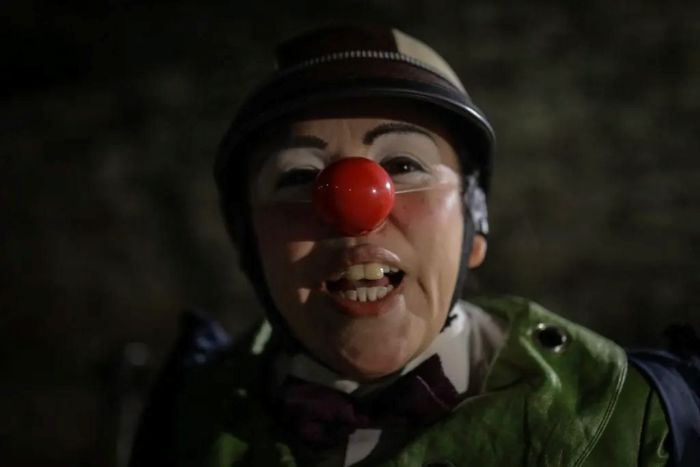
I first discovered Achilles while watching a clown show in the East Village called The Idiot’s Hour. It is impossible and irresponsible to write about current trends in live comedy and ignore the burgeoning alt-clown movement. It is hard to pin down alt-clown without the broadest of definitions, so I’ll connect the few points of commonality with all the acts I have seen: alt-clown involves a comedian playing a character, not appearing as themselves; the fourth wall is far more porous than at a stand-up or improv show. An improv team asks for a suggestion of a scene idea (usually a one-word suggestion) and then improvises with the understanding that the audience cannot interact with them again until they are prompted for a new scene suggestion. A stand-up, even in the heady alt days, maintained a clear hierarchical relationship between the comedian and the crowd (some of the funniest moments were when a wacky character shut down a heckler). An alt-clown involves the audience, sometimes in a call-and-response manner, sometimes as a game. One alt-clown, Sebastian Maroun, has a bit where he mimes shooting random audience members. If and when an audience member decides to mime shooting back, he pretends to be shot, but then comes back like an invincible action hero in comedically preposterous ways.
Much of alt-clown in New York is centered in Bushwick, where I live, so I had to do some original reporting, especially since relatively little has been written about the smaller and more recent New York scene compared to the reportedly massive LA movement. I will refer you to the New York Magazine article “The Rise of the Fool” if you want to know more about Los Angeles. Otherwise please indulge me one paragraph (or more) to give you the history of the New York alt-clown scene, which I have cobbled together from my own online research along with background interviews with clowns (Alyna Perry, Kevin Allen, Alexandra Tatarsky, Matthew Silver) and clown teachers (Julia Proctor, Virginia Scott, Jeff Seal).
Before alt-clown, there were primarily two styles: the circus style and the theatrical pedagogy of teachers like Jacques LeCoq, Philippe Gaulier, and Christopher Bayes. More than a decade ago, two things happened: in Philadelphia, the Pig Iron School was founded, which taught the Lecoq method; in Los Angeles, John Gilkey started The Idiot Workshop, where a new kind of clown called “idiot” was taught. “No clown nose, really a combo of clown and bouffon — with a certain detached, ’70s, absurdist aesthetic,” Virginia Scott says. “I think this is really the basis for what a lot of people are doing with clown in NYC now.” The Pig Iron Theater company was founded by Dito van Reigersberg, who performed under the drag persona Martha Graham Cracker. Alexandra Tatarsky credits them as an inspiration and LA clown Natalie Palamides (who has a Netflix clown special, Nate) recently sang their praises on Instagram when they died in June of this year. “For years there has been a whole rich weird stinky trashy surreal clown scene in Philly — I really think this current clown craze spread to NY and LA from Philly and from the world of dance/theater/clown/noise/performance art /drag that was swirling around there,” Tatarsky says. In 2014, a manic street performer named Matthew Silver produced a variety show called Circus of Dreams at a since-closed bar in Bushwick called Bizarre. Silver let go of the reins a year later to focus on his career. That same year, Bayes student Julia Proctor founded Clown Gym, a series of workshops for clowns to practice their craft.
Once the pandemic hit, Proctor moved these workshops online. Clowns desperate to practice worldwide began to attend. “When we came back in person in the fall of 2021 the classes were in high demand. We had to start advanced registration because we were selling out,” Proctor says. Brooklyn Comedy Collective (BCC) also began teaching sold-out clown classes. “UCB closed and the PIT left its bigger theater space on 24th so there was a void in the NY comedy scene and the clowns crawled out of the rubble like cockroaches after a nuclear bomb dropped,” BCC teacher Jeff Seal says. By 2023, Proctor was producing a show at Pine Box Rock Shop in Bushwick called Clown Flex that drew huge crowds. “It grew from people’s desire to perform and desire for in-person connection,” Kevin Allen says. The year 2023 was big for alt-clown in New York: Silver produced The Village Idiot’s Hour clown show at Sunflower Arcade Lounge in the Village and the first Clown Cult (produced by Chuckie Sleaze) hosted their drag clown parties at Rubulad in Bushwick. Both shows moved — The Idiot’s Hour to Baker Falls in 2025 and Clown Cult to Three Dollar Bill in Williamsburg this year.
There are clear parallels to the beginnings of alt-comedy: both have roots in cities that are not show business meccas (Boston for alt-comedy, Philadelphia for alt-clown); both exploded in Los Angeles; both have a more aggressively experimental style in New York than in LA. “There are definitely people leaping onto stages wild out there,” says Travis Nichols, a clown who regularly performs at The Idiot’s Hour. One major difference this time though, even compared to the post-alt stand-up scene: a skepticism of tech. “Clown is — in so many ways — the opposite of social media,” Nichols says. Cvnty Freud, another regular whose act consists of impersonating Freud as a sassy queen, adds, “I would say content creation really can’t possess the same elements as clown because you’re not engaging or reacting with an audience, but bringing my character to the ‘real world’ is where the clown comes to life.”
It seems New York is even about to have its homegrown hit one-person clown show in response to the flurry of shows that have come from Los Angeles. Non-binary clown Suz Murray has been workshopping their show “Kachonk” based on their character of the same name. Despite Suz Murray being non-binary and Kachonk being a robotic character, the show’s examination of work/life balance is universal enough for anyone to identify with. As journalist Luke Winkie wrote in the Slate article “Send in the Clowns” in 2024, “This generation of clowns are . . . gloriously unburdened by the suffocating discourse that has so thoroughly eviscerated the stand-up scene.” “Kachonk” is easily the most political clown act I have seen and even it is not overtly didactic. Like The Wizard of Oz, a child can watch it and not get the message until they rewatch it as an adult.
It is too soon to say whether clown of any type will be a formidable force in art or entertainment, but what can’t be denied is, more than any other creative trend, micro or macro, clown has signified the most violent rupture with the past, like alt-comedy 20 years ago. In 2015, the verdict was in at the comedy blog Splitsider: clowns hid their vulnerability behind greasepaint and we wanted to see what was behind the paint, which was why more vulnerable stand-up like Louis CK’s was so appealing (this was 2015).6 Now it can be argued that, while alt-clowns may not be autobiographical, they often reveal an inner self that has been unsocialized and allowed to play onstage without any repression.
Even improv, which has suffered the most after 2020, to the point of beginning its extinction arc like vaudeville did almost a century ago, has had a revival thanks to the streaming service Dropout. The shows, including the hit game show Game Changer, use improv comedians; unlike traditional networks, streaming or otherwise, they are encouraged to improvise without a script.
This is the closest thing the internet has to an alternative comedy venue, as an alternative to social media and streaming behemoths like Netflix. Erin English, a trans clown who also produces the livestream for The Idiot’s Hour, is inspired by their success. “I also have dreams of building a sort of streaming platform for clown shows to provide both live and prerecorded shows for a larger audience, sort of like Dropout for clown,” English told me.
In a rant that went viral late last year, improv and stand-up comedian Chris Gethard warned that, with comedians increasingly spending money on production costs for content and even their own specials, the alternative comedy middle class that was thriving a decade ago is about to go extinct. The answer to the question “What was alternative comedy?” if taken literally, is, “It was a business model.” In the ’90s it began with alternative venues. In the following two decades, alternative media expanded its reach. A revival cannot happen without a new, viable business model.
The question was not meant to be literal of course. It was meant to evaluate its legacy and significance. To that end, I throw my hands up and say that comedy still does not hold up to hagiography. The Lapides and Garofalo school may have been right all along. Posterity is not as important as the moment. In the ’90s there weren’t that many one-hour alt-comedy specials for that reason. But even many of the structures where ’00s alt-comedy thrived are gone. Rififi is closed. A Special Thing now exists only as the stuff of lore. Comedy albums are not getting illustrious reissues. It might be impossible to explain the delirious euphoria of turn-of-the-century comedy. Perhaps you had to be there.

Mo Diggs, a contributing writer to The Metropolitan Review, writes about tech, culture, and legacy media. His Substack, Cross Current, looks at the intersection between the new media trends of today and the legacy media trends of yesterday. It has been mentioned in the New York Times and the Guardian.